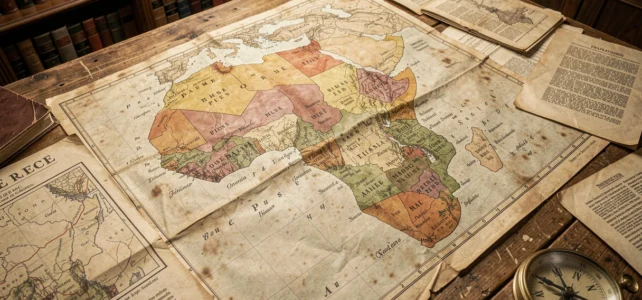
France exercised colonial domination over about twenty African territories between the 19th century and the 1960s. This figure, often cited without caution, masks a more complex administrative reality: depending on whether one counts full colonies, protectorates, or international mandates, the total varies. Understanding the distinction between these legal statuses is a prerequisite for any reliable answer.
Colony, protectorate, mandate: distinct legal statuses in Africa
Before counting, it is necessary to define what “colonizing” entails. The French colonial empire in Africa never operated under a single regime. Three main categories structured the administration of the territories.
The full colony refers to a territory placed under the direct sovereignty of France, administered by a governor appointed from Paris. Algeria, conquered starting in 1830, is the most well-known example, with a special status as French departments from 1848.
The protectorate theoretically maintains local institutions (monarchy, traditional administration), but real power is exercised by a French general resident. Morocco and Tunisia fell under this regime. Historians remind us that these two countries are not colonies in the strict sense, even if French domination was effective there.
The mandate, finally, concerned territories entrusted by the League of Nations after World War I, such as Cameroon and Togo, which were previously under German administration. France exercised international oversight there, not full sovereignty.
This distinction is not anecdotal: it explains why the question of how many countries France colonized in Africa never produces a single answer in historical literature.

AOF and AEF: the two French colonial federations in Sub-Saharan Africa
The essence of French colonial presence in Sub-Saharan Africa was organized around two major administrative entities created at the end of the 19th century and the beginning of the 20th.
French West Africa
AOF included eight territories that correspond today to Senegal, Mauritania, Mali, Guinea, Ivory Coast, Niger, Burkina Faso, and Benin. The seat of the general government was located in Dakar. AOF covered a considerable area, from the Atlantic to the edges of the Sahara.
French Equatorial Africa
AEF gathered four territories: Chad, the Central African Republic (then Oubangui-Chari), Congo-Brazzaville (Middle Congo), and Gabon. Brazzaville was its administrative capital.
These two federations alone represented twelve future independent states. Their organization into administrative blocks had a direct consequence: the internal borders, drawn according to colonial logics, became international borders during the independence movements of 1960.
List of African territories under French colonial domination
By adding colonies, protectorates, and mandates, the list of African territories that were under French control is as follows:
- North Africa: Algeria (colony then departments), Tunisia (protectorate), Morocco (protectorate)
- AOF: Senegal, Mauritania, Mali (French Sudan), Guinea, Ivory Coast, Niger, Burkina Faso (Upper Volta), Benin (Dahomey)
- AEF: Chad, Central African Republic (Oubangui-Chari), Congo-Brazzaville (Middle Congo), Gabon
- Mandates and other territories: Cameroon, Togo, Madagascar, Djibouti (French Somaliland), Comoros
The total reaches about twenty territories. The exact figure depends on the criteria used: if only full colonies are counted, the number drops below fifteen. If protectorates, mandates, and island territories in the Indian Ocean are included, it exceeds twenty.

Why the count of former French colonies varies by source
The idea of counting “countries” colonized is based on a posteriori reconstruction. The current borders of African states did not exist during colonization. French Sudan became Mali, Dahomey became Benin, Upper Volta took the name Burkina Faso. Counting “countries” amounts to projecting a contemporary political map onto a very different administrative reality.
Moreover, some territories changed status over time. Madagascar successively experienced the status of protectorate and then colony. Algeria, initially conquered by military force, was integrated as a French department, which legally distinguished it from all other African possessions.
The duration of domination also varies considerably. Algeria was under French control for more than a century (1830-1962). Cameroon and Togo were only administered by France from the end of World War I, about forty years before their independence.
African independences: a wave concentrated around 1960
The majority of French territories in Sub-Saharan Africa gained independence in the same year, 1960. This simultaneity is not coincidental: it results from the Defferre framework law of 1956, which granted internal autonomy to overseas territories, followed by the constitutional referendum of 1958 proposed by de Gaulle, which offered the choice between integration into the French Community or independence.
Only Guinea under Sékou Touré voted “no” as early as 1958, achieving immediate independence. The other territories first joined the Community before negotiating their sovereignty during the year 1960. Algeria followed a radically different path, marked by a nearly eight-year war of independence, concluded by the Évian Accords in 1962.
The question of how many countries France colonized in Africa therefore does not have a simple arithmetic answer. It depends on the legal status considered, the period in question, and the very definition of “country” applied to entities that did not have this status during colonization. This methodological ambiguity explains the discrepancies between sources and makes the precision of the terms used all the more necessary.