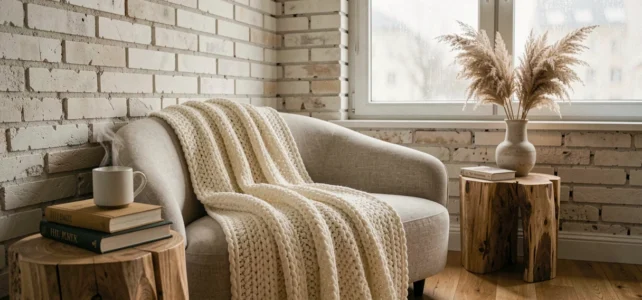
Transforming a house into a warm cocoon is not just about piling blankets on a sofa. The choice of materials, the color temperature of the lighting, and the balance between decorative styles create measurable effects on the feeling of a space. This article compares the concrete levers that tip a room towards coziness, relying on documented trends for the 2025-2026 season.
Cocooning Hybrid Styles: Comparing Japandi, Wabi-Sabi, and Cottagecore
The competitors almost all focus on classic Scandinavian coziness. Recent trends show a migration towards more pronounced hybrid styles that redefine the warm living room.
| Criterion | Japandi | Wabi-Sabi | Cottagecore |
|---|---|---|---|
| Dominant Palette | Neutrals, deep green | Earthy tones, ochre | Pastels, cream, powder pink |
| Key Materials | Light wood, linen, ceramics | Raw stoneware, patinated wood, stone | Velvet, lace, floral cotton |
| Clutter Level | Minimal | Moderate (embracing imperfect objects) | High (controlled accumulation) |
| Suitable for Small Spaces | Yes | Yes | More delicate |
| Lighting Ambiance | Maximized natural light | Chiaroscuro, candles | Soft light, textile lampshades |
Japandi combines Japanese minimalism and Scandinavian warmth, making it the most versatile style for a contemporary cozy interior. Wabi-sabi, on the other hand, values the imperfection of raw materials: a chipped stoneware bowl or an unpolished wooden piece becomes a decorative item in its own right.
Cottagecore appeals to those who prefer a romantic countryside universe, with dried flowers, velvet cushions, and doilies. This style works best in spacious rooms, as the accumulation of objects can quickly overwhelm a small living room.
Rather than choosing a single style, the current trend encourages crossovers. A Japandi-style sofa covered with a raw wool wabi-sabi blanket creates an interesting visual tension, and it is precisely this mix that gives a space its character. To explore other approaches to interior decoration, the home articles on Scoopzilla detail several style combinations suitable for each room.
Cocooning Color Palette 2025-2026: The End of All-Beige
Cocooning palettes are evolving significantly. Beige and off-white remain safe bets, but two colors are asserting themselves in this season’s trendy interiors.
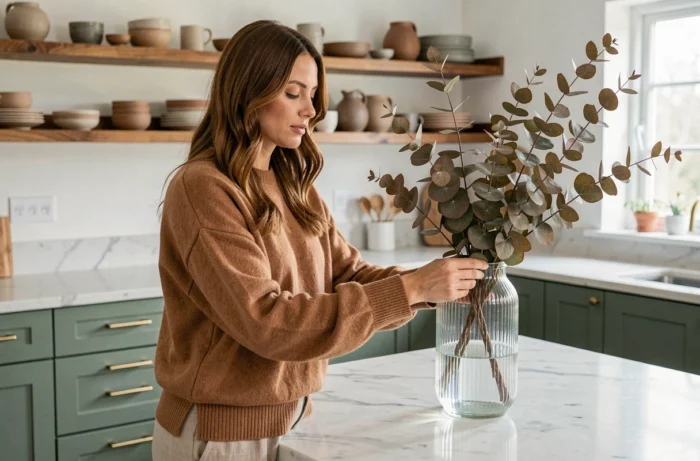
Sage green is establishing itself as a structuring color for current cozy living rooms. Applied to an accent wall or reflected in textiles (cushions, curtains), it anchors the room in a lively atmosphere without cooling it down. Its ability to pair well with both light wood and earthy tones explains its rise.
Calming blue, more subdued, emerges as the key shade for the 2026 season, particularly on sofas. However, it requires careful accompaniment: when paired with overly cool lighting, it produces the opposite effect of what is desired and pulls the space towards a clinical ambiance.
Color Combinations That Work
- Sage green as an accent wall, paired with ecru linen and light oak wood, for a bright and organic living room.
- Calming blue on the sofa, enhanced by cushions in ochre or terracotta, with mandatory warm lighting.
- Soft brown in the base or low furniture, combined with an off-white ceiling and ivory boucle wool textiles.
A common mistake is to multiply trendy colors in the same room. An effective cocooning palette does not exceed three dominant shades, with the rest coming from materials and textures.
Cozy Lighting: Color Temperature and Source Arrangement
Lighting is the most underestimated lever in creating a cozy atmosphere. Most guides simply recommend adding candles or choosing warm light, without specifying what that means in practice.
Color temperature is measured in kelvins. For a cozy interior, aim for bulbs located in the lower part of the spectrum, around amber tones. Dimmable LED bulbs allow you to adjust the intensity according to the time of day, which radically changes the perception of the same space between morning and evening.
Arrangement of Light Sources in the Living Room
A single central ceiling light is the enemy of coziness. It flattens volumes and removes shadow areas that add depth to a room. Multiplying low light points creates islands of visual warmth in the living room.
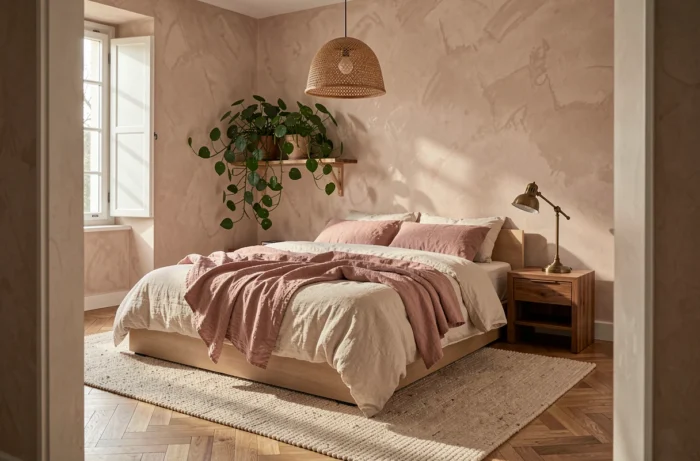
In practice, three types of sources are sufficient: a reading lamp near the sofa, a discreet string of lights along a shelf or window frame, and candles (real or LED) placed on a coffee table or console. The goal is for each area of the living room to have its own light, at a different height.
Conversely, lighting that is only indirect (LED strips behind a piece of furniture) without any visible source gives a cold and impersonal result. At least one visible light source per living area is enough to restore the desired warmth.
Materials and Textures: The Tactile Factor of Cocooning Decor
The tactile dimension is what distinguishes a successful cozy interior from a decor that merely resembles a Pinterest photo. Touch plays as much of a role as sight in the perception of comfort.
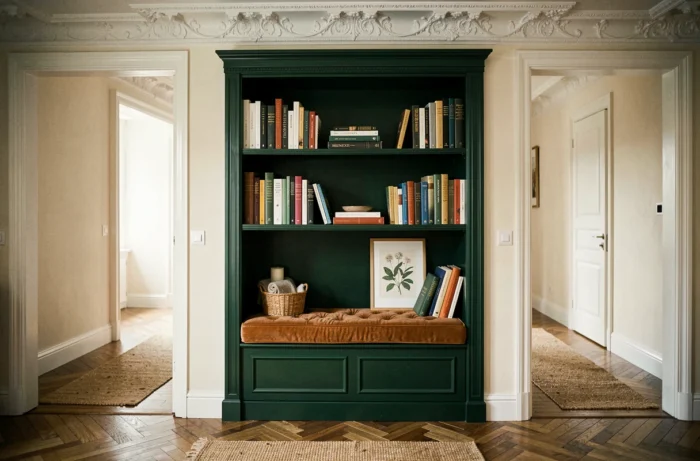
The principle is based on layering contrasting textures. A boucle fabric sofa paired with a knitted wool blanket and washed linen cushions offers three different sensations to the touch. This contrast produces a sensory richness that smooth and uniform surfaces do not allow.
Wood remains the king material of a warm atmosphere, provided it is left exposed rather than lacquered. Natural fibers (jute, sisal, rattan) add texture to the floor or storage. Every cozy room benefits from mixing at least three different materials to avoid visual monotony.
Shiny synthetic materials (plastic, chrome metal, lacquered glass) break the cocooning effect. If a metal piece is necessary, brushed brass or matte black iron integrates much better than polished steel.
The goal is not to change everything at once, but to identify the dominant surfaces in each room and introduce a textile or natural counterpoint. A simple linen table runner on a wooden console, a wicker basket next to the sofa, or a long-pile rug under the coffee table can sometimes be enough to shift the ambiance of a room towards a true warm cocoon.