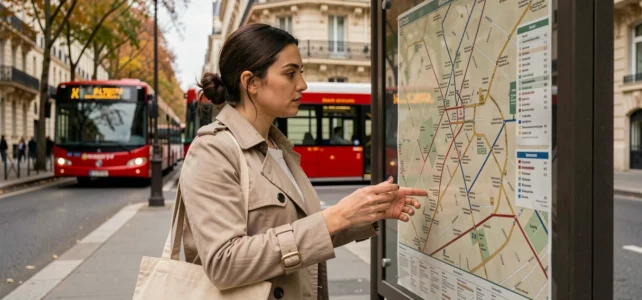
The restructuring of the Paris bus network, led by Île-de-France Mobilités and RATP, has redefined the logic of service within the city and towards the inner suburbs. With several dozen modified lines and new creations, the current network is based on matching principles that deserve a technical reading, particularly at the intersection of transport tickets and multimodal exchange hubs.
Fare separation between bus-tram and metro-RER: the connection knot
The 2025 fare reform in Île-de-France has unified the price of metro, RER, and train tickets across the region. However, it has maintained a clear separation between bus-tram tickets and metro-train-RER tickets. This distinction directly impacts the fluidity of connections on a daily basis.
A bus-tram ticket allows for transfers for about 90 minutes between bus and tram lines but does not grant access to the metro or RER. Conversely, a metro-RER ticket does not cover the bus-tram network, except under certain Navigo-type packages.
We observe that the redesign of the bus map in Paris has simplified the routing of lines and the physical connections between stops, but this advancement is not accompanied by an equivalent simplification on the ticketing side. A traveler getting off bus 45 at Concorde to take metro line 1 must validate a second transport ticket, creating an invisible fare break on the map but very real in practice.
Free transfers versus paid transfers
The rule is simple on paper: bus to bus or tram, free within the 90-minute window. Bus to metro or RER, paid unless under a package. This logic poses problems on lines extended to the inner suburbs, where the bus often serves as the first link in a multimodal journey.
Holders of a monthly or annual Navigo pass do not perceive this friction. For occasional users with single tickets, the bus-metro transfer represents a systematic extra cost that the new line plan does not resolve.
New lines and extensions: what the map concretely changes
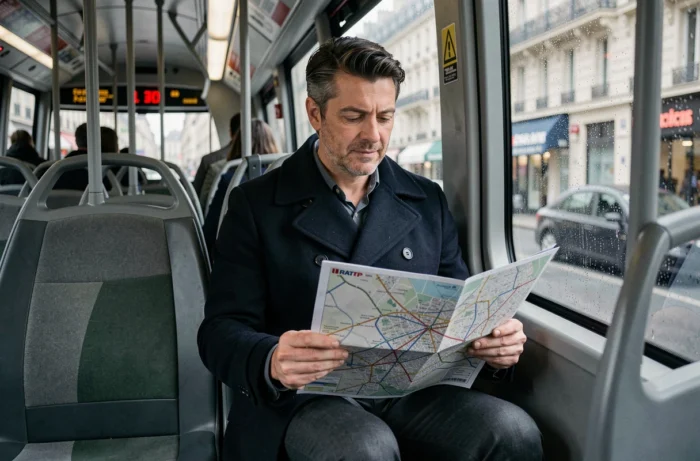
The restructured network has introduced several new lines and extended existing ones. Line 45, connecting Concorde to Aubervilliers-Saint-Denis, and line 59, between Clamart-Percy and Place d’Italie, are among the most significant creations. These routes respond to an old observation: the network inherited from the 1950s largely ignored the inner suburbs.
Other extensions deserve attention. Line 163, whose terminus has been moved from Porte de Champerret to Pont Cardinet, illustrates the desire to create more direct connections with railway hubs. Line 71, from Porte de la Villette to Bibliothèque François Mitterrand, outlines a north-south axis that did not previously exist.
Redistribution of duplicates within the city
A less commented aspect of the reform concerns the elimination of overlapping lines in central Paris. On Rue de Rivoli, several lines traveled the same route for several kilometers. The restructuring has redistributed these routes to cover previously underserved parallel axes.
This redeployment has a direct consequence on waiting times. Where three lines used to pass at the same stop, sometimes only one remains, with an adjusted frequency. The average interval on restructured lines now depends much more on the time of day than before, which requires checking schedules rather than relying on frequent passage.
Contactless payment and validation on buses: what changes for transfers
RATP has rolled out contactless payment by credit card and via mobile apps across the entire Paris bus network. This technical evolution concretely modifies the management of transfers.
- Payment by credit card at the bus validator automatically records the time of the first validation, activating the 90-minute bus-tram transfer window without additional manipulation.
- Compatible NFC apps (smartphones, smartwatches) operate under the same daily capping logic, but the bus to metro transfer remains charged separately in the absence of a package.
- The risk of fines persists for travelers who confuse bank validation with multimodal coverage: a contactless payment on the bus does not count as a metro ticket, even on the same journey.
We recommend regular users who combine bus and metro to prefer the Navigo package rather than paying by bank card per journey, which remains penalizing as soon as a mode change occurs.
Bus-metro-RER transfer hubs: the nodes to know
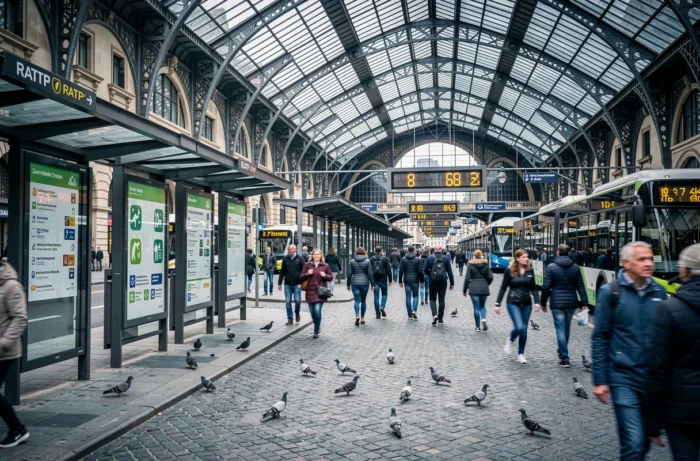
The restructuring has strengthened certain exchange hubs while creating new ones. Concorde, Gare de Lyon, Place d’Italie, and Bibliothèque François Mitterrand now concentrate an increased number of bus lines connected to the metro and RER.
The logic of these hubs is based on a funneling principle: bus lines feed metro or RER stations located on the edge of Paris, rather than crossing the city parallel to the underground lines. This scheme reduces overall travel times for suburb-center journeys, provided that transfers are managed effectively.
Points of caution regarding transfer times
Walking times between a bus stop and a station entrance vary significantly depending on the hubs. At Gare de Lyon, the distance between some bus stops and the RER D platforms can exceed several minutes of walking. The line map does not reflect the physical distance between transfer points, which can distort the estimation of a journey.
- Check the exact position of the bus stop relative to the nearest metro or RER access, via a real-time transport app.
- Incorporate a realistic transfer margin, especially at high-traffic hubs where pedestrian density lengthens the journey.
- On lines extended to the inner suburbs, anticipate that frequency decreases significantly during off-peak hours.
The new Paris bus network gains in geographical coherence, with clearer suburb-center connections and fewer duplicates in the center. The main limitation remains the disconnection between cartographic simplification and fare reality, which still imposes two distinct ticketing logics depending on whether the journey stays on the surface network or shifts to the underground.