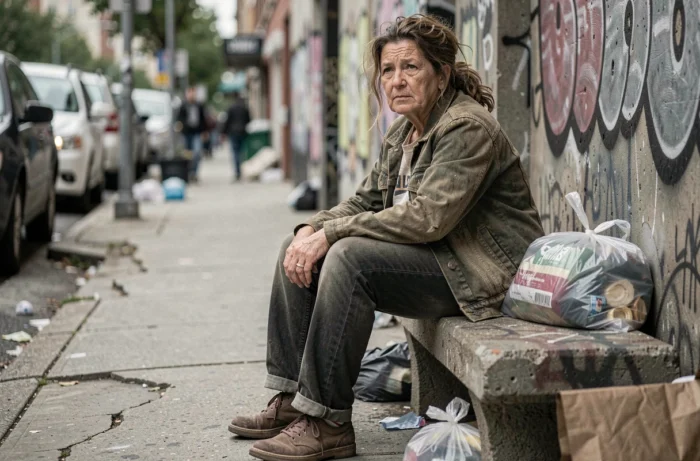
Loni Willison, former fitness model and ex-wife of actor Jeremy Jackson, has been homeless on the streets of Los Angeles since the second half of the 2010s. As of 2026, her situation remains unchanged: she is still alive, still homeless, and her main source of income relies on collecting cans and aluminum bottles.
Can Collection and Daily Survival: Loni Willison’s Lifestyle in Los Angeles
The viral content circulating on TikTok or Instagram consistently shows the same glamorous photos from her career, followed by recent snapshots taken on the street. This visual treatment obscures a concrete aspect of her daily life that French-speaking media rarely address.
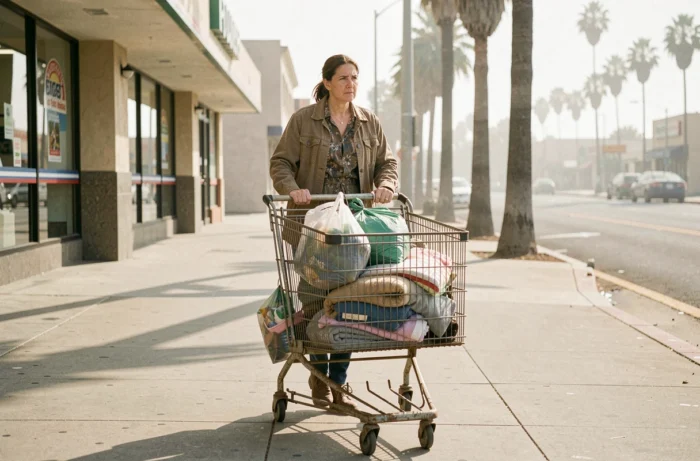
Since at least 2018, Loni Willison has survived by collecting cans and bottles that she sells for small amounts. This is not a trivial detail: it is the material foundation of her daily life. Recent observations show her pushing a shopping cart filled with bags through the streets of Los Angeles, which corresponds to this mode of subsistence.
Several English-speaking and European sources published in 2025 and 2026 confirm that she has not disappeared and that she still frequents the same neighborhoods. To better understand Loni Willison and her journey in 2026, one must go beyond the simplistic before/after narrative that social media recycles endlessly.
Refusal of Help and Voluntary Non-Hygiene: Loni Willison’s Protection Strategies
One element rarely mentioned in French media coverage concerns the reasons she cites for staying on the street. According to English-speaking sources from 2026, Loni Willison claims to feel safer without a home than she has in other contexts of her life. She repeatedly refuses help offered by her loved ones.
This refusal is not merely stubbornness. It is part of a mechanism documented in individuals who have experienced prolonged domestic violence. Her divorce from Jeremy Jackson, marked by episodes of violence, was a turning point. The street, paradoxically, represents for her an environment she feels she can control more.
Another aspect illustrates this logic of protection: she voluntarily refrains from washing for long periods to reduce the risk of sexual assaults. This deliberate non-hygiene strategy is known to social workers who intervene with homeless women, but it is very rarely reported in articles about Loni Willison.
What This Refusal Reveals About the California Aid System
The fact that a person prefers the street to any form of shelter raises questions about the nature of the services offered. The shelters in Los Angeles are regularly described as places where women face theft and assaults. Refusing help does not equate to refusing to get better: it is sometimes a rational calculation based on a concrete experience of danger.
Loni Willison and Substance Use: Methamphetamine and Inhalants
French-speaking media mention “drugs” without ever specifying which substances are involved. English-speaking sources are more explicit: the main documented addiction is methamphetamine, a substance that causes rapid neurological and physical damage.
In October 2024, photos published by OK! Magazine added an additional element. Loni Willison is seen inhaling what appears to be paint or a solvent. The use of volatile substances (inhalants) constitutes a distinct form of addiction from methamphetamine, with its own risks: brain damage, liver damage, sudden cardiac arrest.
This combination of substances makes any medical intervention particularly complex. Withdrawal protocols for methamphetamine differ from those suited for inhalants, and the simultaneous addictions require specialized care that California’s emergency services do not systematically provide.

Media Exploitation and Lack of Legal Protection for Filmed Homeless Individuals
Every wave of virality surrounding Loni Willison follows the same pattern. Videographers go to the neighborhoods where she has been spotted to film her without her consent. This content generates hundreds of thousands of views. Creators who express outrage at her situation simultaneously participate in the exploitation of her image.
In California, there is no legal mechanism that effectively protects a homeless person from this type of filming. The right to one’s image, as it exists in other jurisdictions, does not apply in the same way when the filmed person is in a public space and lacks the resources to initiate legal proceedings.
This legal vacuum creates a vicious cycle:
- Viral videos draw attention to Loni Willison, generating new visits from videographers to her usual neighborhoods
- The algorithms of platforms favor emotionally contrasting content (before/after), financially rewarding creators who publish this type of montage
- The filmed person receives no income from this exposure and has no practical recourse to stop it
The Line Between Documentation and Poverty Tourism
Documenting the homelessness crisis in Los Angeles has social utility. Filming an identifiable woman inhaling substances to accumulate views has none. The difference lies in the intent and treatment: a journalistic report contextualizes, verifies, and protects. A 30-second Reel with sad music does none of this.
Loni Willison’s situation in 2026 has not changed compared to previous years. She remains in Los Angeles, collects cans, refuses help, and lives according to survival strategies she has built over the years. The only measurable change concerns the volume of content produced about her, which continues to increase without any of this content altering her daily reality.