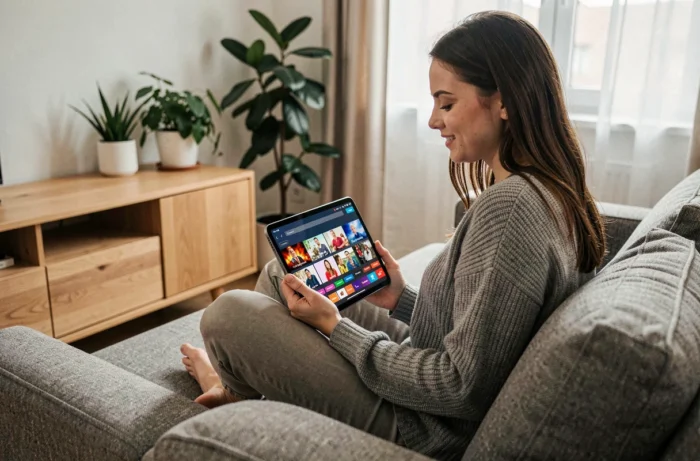
Terrestrial DTT remains the historical foundation of free television in France, but recent figures show a clear shift in usage. According to data relayed by Arcom and the specialized press, only 34% of households still use DTT on at least one television, and barely 14% rely exclusively on the antenna. Free TV streaming applications are taking over, on smartphones, tablets, PCs, or connected TVs.
The landscape of these solutions deserves careful examination, as not all offer the same channel coverage or constraints.
Reduction of the terrestrial network: what changes for DTT reception
The structural event of 2026, little addressed in application guides, concerns the terrestrial coverage itself. For the first time, DTT coverage will be deliberately reduced: transmitters are being shut down as part of tests aimed at lowering broadcasting costs, in response to the continuous decline in antenna audiences.
Households affected by these shutdowns will need to switch to satellite (Fransat, TNT Sat) or internet TV, with financial support for equipment costs from the channels. This optimization of the network mechanically pushes more viewers towards free OTT applications.
Meanwhile, on operator boxes, linear free TV remains the dominant mode of consumption. However, on connected TVs without a box, video-on-demand platforms and FAST channels (free ad-supported streaming) are gaining ground. This context explains why there are now several complementary ways to watch DTT for free on your devices, depending on the equipment you have.

Free DTT applications on Android and iOS: what each actually covers
Most guides list the same names without detailing the differences in scope. Three applications deserve a precise analysis.
Free TV (formerly OQEE by Free)
This is the most notable change in recent months. The Free TV application, formerly OQEE, is now open to everyone, even without a Free subscription. It provides access to most DTT channels live, with replay and program restart from the beginning. The interface, originally designed for televisions, also works on Android or iOS smartphones and tablets.
The main limitation: some private channels may restrict mobile broadcasting based on rights agreements. Therefore, the replay catalog varies from one device to another.
Molotov
Molotov remains the best-known aggregator. The free version provides access to about thirty DTT channels live, with an integrated program guide. The application is available on Android, iOS, Apple TV, Android TV, and web browsers.
The free version includes ads and limits replay to a few hours. To access extended replay or cloud recording, you need to switch to a paid plan. This distinction is not always clear in the marketing presentations of the application.
Channel applications: france.tv, TF1+, M6+, RMC BFM Play
Each major audiovisual group offers its own free application. Their advantage over aggregators: a replay catalog that is often more complete for their own programs, and sometimes exclusive content (bonuses, previews).
- france.tv covers all channels of the France Télévisions group (France 2, France 3, France 4, France 5) with generous replay and regional live broadcasts
- TF1+ includes TF1, TMC, TFX, and LCI with free access to live and replay, provided you create an account
- M6+ gives access to M6, W9, and 6ter, with replay available on Android and iOS
- RMC BFM Play broadcasts BFM TV, RMC Découverte, and RMC Story live and on replay
The downside: you have to juggle between four or five applications to cover all of DTT. This is exactly the problem that aggregators like Molotov or Free TV are trying to solve.
Watching DTT on PC and connected TV without an operator box
The case of the PC remains under-documented. Molotov works via a web browser, making it the most direct solution for a computer. The channels’ websites (france.tv, tf1+.fr, 6play.fr) also offer live streaming from a browser, without installation.
On a connected TV (Samsung Smart TV, LG, Android TV), the Molotov, Free TV, and channel applications are generally available in the integrated stores. Android TV offers the widest catalog of DTT applications, ahead of Tizen (Samsung) and webOS (LG) where some applications arrive late.
Another option exists for advanced users: Kodi, the open-source media player, combined with the CatchUpTV&More extension. This extension aggregates replay and sometimes live streams from French channels. The setup requires some manipulation, but the tool works on PC, Android, Android TV, and even Raspberry Pi.
Limitations and points of caution before choosing a DTT application
The free nature of these applications relies on advertising. Molotov, TF1+, and M6+ insert ad breaks into the streams, including during live broadcasts. None of these applications allow you to eliminate ads without switching to a paid offer.
The quality of the broadcast also depends on your internet connection. Unlike terrestrial reception, streaming consumes bandwidth. On a 4G mobile network, consumption can reach several gigabytes per hour in high definition.
- Check that your mobile plan includes enough data if you watch TV on the go
- On Wi-Fi, prefer the 5 GHz band to reduce latency and stuttering
- Some applications automatically adjust quality to the available bandwidth, while others require manual adjustment in the settings
Field feedback varies on the reliability of streams during peak hours, especially for highly followed sporting events. Channel applications sometimes handle load better than aggregators because they directly control their broadcasting infrastructure.
The gradual reduction of the terrestrial network and the rise of free applications are shaping a landscape where DTT over the internet becomes the norm for a majority of households. The choice between a single aggregator and a collection of channel applications primarily depends on your tolerance for advertising, the desired depth of replay, and the type of device you use daily.