
The national identity card (CNI) displays an expiration date on its front side, but this date does not always reflect the actual legal validity of the document. The discrepancy between the printed date and the effective validity traps travelers at the boarding counter each year and complicates administrative procedures. Understanding the extension mechanisms and the available verification tools can help avoid these situations.
Automatic extension of the CNI: cases where the printed date is misleading
The decree of December 18, 2013, extended the validity period of identity cards from 10 to 15 years, but only for cards issued to adults between January 2, 2004, and December 31, 2013. This 5-year extension applies automatically, without any physical modification of the document. The expiration date printed on the card therefore remains unchanged, which generates persistent confusion.
We observe that many of these extended cards reach their true end of validity between 2024 and 2028. A CNI issued in 2010 to an adult shows an expiration date in 2020 but remains legally valid until 2025. After this point, the document becomes invalid overnight, without the holder necessarily being informed.
A technical point often overlooked in consumer guides concerns the online resources that detail the verification of identity on News Connect and help better understand these regulatory subtleties.
Cards issued to minors: no extension
CNI issued to minors between 2004 and 2013 do not benefit from any extension of validity. It is a common mistake to assume otherwise. The automatic extension depends on the age of the holder at the time of issuance, not solely on the issuance period. A card obtained at 16 years old in 2009 expired in 2019, period.
To eliminate any doubt, two pieces of information must be cross-referenced: the date of issuance and the age of the holder at that date. If the holder was a minor, the validity remains strictly 10 years.

Calculating the actual validity date of a French identity card
The calculation method depends on the format of the card and the holder’s situation at the time of issuance.
- Card issued to an adult between January 2, 2004, and December 31, 2013: add 15 years to the date of issuance (not 10 years as indicated on the card).
- Card issued to a minor between 2004 and 2013: the printed date is authoritative, the validity is 10 years without extension.
- Card issued before 2004: validity of 10 years, no extension. The document is necessarily expired.
- Card in the new format (since 2021, banking card format in polycarbonate with electronic chip): validity of 10 years, the printed date corresponds to reality.
The simulator available on the Service-Public.fr website allows you to check the validity of a CNI by providing the date of issuance and the holder’s situation. We recommend using it systematically before a trip, opening an account, or any procedure requiring a valid identity document.
The MRZ band as a quick control tool
The machine-readable zone (MRZ), consisting of two lines of characters at the bottom of the card, contains the encoded expiration date. On older laminated cards, the MRZ date reflects the initial validity of 10 years, not the extension. Border control agents are generally aware of this, but some foreign countries refuse the document if the MRZ date has passed, extension or not.
On the new CNI format, the electronic chip stores biometric data and the actual validity date. An NFC reader can extract this information, simplifying control for airlines and equipped administrations.
Validity of the identity card abroad: frequent refusals despite extension
The automatic 5-year extension is a provision of French law. Several foreign countries do not recognize it and refuse CNIs whose printed date has expired. This refusal applies to both destinations outside the European Union and certain counters within the European area, depending on the assessment of the control agent.
In practice, we find that refusals mainly occur in countries that are not on the official list of states that have notified their acceptance of the extension. The Ministry of Foreign Affairs’ website publishes this list, which is regularly updated.
For travel abroad, the most reliable precaution remains to hold a card whose printed expiration date has not passed, or to travel with a valid biometric passport. No official extension certificate is uniformly recognized by foreign authorities.
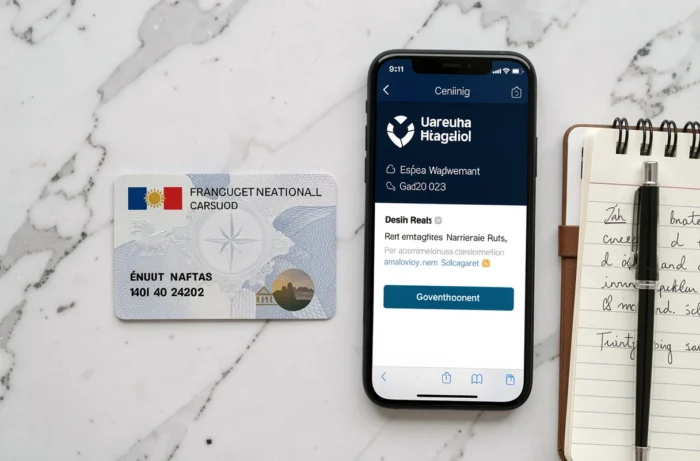
France Identité: verify your identity card via the mobile application
The France Identité application, deployed by the State, allows for the creation of a certified digital identity from a CNI in the new format (post-2021). The holder scans the NFC chip of their card with a compatible smartphone, generating a digital identity document usable for certain online procedures.
The application also offers a verification module: a third party can scan the visible electronic seal (CEV) present on the new card format to confirm the authenticity of the document and the consistency of the data. This seal, a 2D barcode signed electronically, encodes the name, first name, and title number.
Current limitations of the digital system
Only CNIs in the new format are compatible with France Identité. Older laminated cards, including those still legally valid due to the extension, do not have an NFC chip and remain excluded from the system. Digital identity does not replace the physical document for border controls or for the majority of counter procedures.
The deployment of France Identité is gradually expanding to new uses, including air boarding at French airports. This extension remains conditioned on holding a document in the recent format and a smartphone equipped with a functional NFC reader.
Thus, verifying the validity of an identity card relies on a cross-reference between the date of issuance, the status of the holder at the time of issuance, and the format of the document. Renewing your CNI before the end of the extension remains the safest way to avoid a refusal, whether in France or abroad.