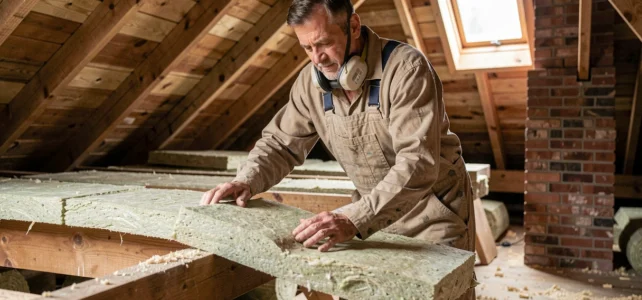
Insulating the attic remains the renovation task that offers the best return on investment in terms of energy savings. According to available data, the roof can account for 25 to 30% of thermal losses in a poorly insulated home. Before choosing an insulation material or technique, one question deserves to be asked: what technical criteria truly separate effective insulation from mediocre insulation, and how have regulatory requirements evolved in recent years?
Required thermal resistance: what the aid sheets say in 2026
Many guides still mention “regulatory” thermal resistance values per wall. The RE2020 no longer works this way: it considers the overall performance of the building through indicators such as Bbio (bioclimatic needs), Cep (primary energy consumption), and DH (degree-hours of summer discomfort).
The often-cited thermal resistance thresholds, R ≥ 7 m².K/W for lost attics and R ≥ 6 m².K/W for converted attics, actually come from the standardized sheets of energy savings certificates (CEE) and the criteria of MaPrimeRénov’. These are eligibility conditions for aid, not obligations of new construction regulations.
This distinction has a direct consequence: a project that only aims for the minimal R of the aids without addressing air tightness or summer comfort can meet the funding conditions while remaining underperforming in practice. The BAR-EN-106 (lost attics) and BAR-EN-101 (sloped ceilings) sheets precisely frame the controllable insulation levels for obtaining grants.
Seeking to improve attic insulation therefore requires going beyond just the thickness of insulation to integrate all the parameters that condition actual performance.
Comparison of attic insulation materials: price, performance, and limitations
The choice of insulation material determines both the budget, durability, and summer thermal behavior of the insulation. The table below summarizes the available data for the most common materials in 2026.
| Insulation Material | Indicative Price (installation included, lost attics) | Thermal Conductivity (lambda) | Summer Behavior |
|---|---|---|---|
| Glass wool | 20 to 50 €/m² | 0.030 to 0.040 W/m.K | Low inertia, limited summer protection |
| Rock wool | 20 to 50 €/m² | 0.034 to 0.040 W/m.K | Higher density, slight phase shift |
| Cellulose wadding | Variable depending on technique | 0.038 to 0.042 W/m.K | Good thermal phase shift due to density |
| Wood fiber | Variable, often higher | 0.036 to 0.046 W/m.K | High phase shift, suitable for converted attics under slopes |
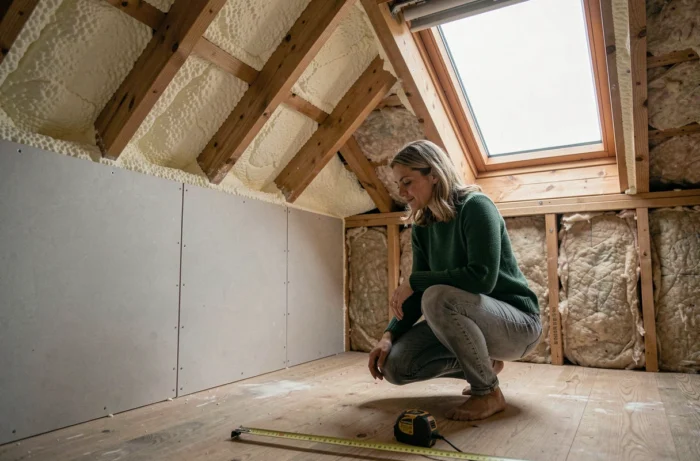
Mineral wools (glass and rock) dominate the market due to their quality-price ratio for lost attics. However, for sun-exposed converted attics, bio-sourced insulations like wood fiber offer significantly superior thermal phase shift, which limits summer overheating.
Cellulose wadding, blown into lost attics, combines good winter thermal resistance with adequate phase shift. Its main weakness remains its sensitivity to moisture if the vapor barrier is poorly installed.
Summer comfort in attics: the parameter that quotes often overlook
RE2020 introduced the DH indicator (degree-hours of summer discomfort), which measures the duration and intensity of overheating inside the building. For converted attics, this criterion changes the game: massively insulating without addressing summer comfort can worsen overheating under the slopes during heatwaves.
A high-performing project therefore does not just stack insulation thickness. It combines three levers:
- The choice of a high-density insulation (wood fiber, cellulose wadding) that slows down the penetration of daytime heat into the interior
- The continuity of air tightness to prevent unwanted infiltrations that negate the effect of the insulation
- External solar protections (shutters, sunshades, night ventilation) that reduce heat gain before it reaches the wall
A lightweight insulation like glass wool, despite a performing lambda, allows heat to pass through within hours under a south-facing roof. Wood fiber can delay this peak by several hours, allowing the nighttime coolness to compensate.
Financial aids 2026 and technical conditions to be met
Assistance programs condition funding on specific criteria. Entrusting the work to a certified RGE craftsman remains mandatory for all public aids.
- MaPrimeRénov’, reopened on February 23, 2026, finances part of the cost based on household income
- The CEE grant (energy savings certificates) represents 5 to 9.5 €/m² for lost attics
- The reduced VAT of 5.5% applies to supply and installation for homes over two years old
- The eco-PTZ allows borrowing up to 50,000 € at zero interest for a bundle of works
Cumulative aids can cover a very significant portion of the total cost, especially for households with modest incomes. Conversely, a project carried out without an RGE craftsman or with insulation that does not meet the thermal resistance threshold required by the CEE sheets loses access to all these programs.
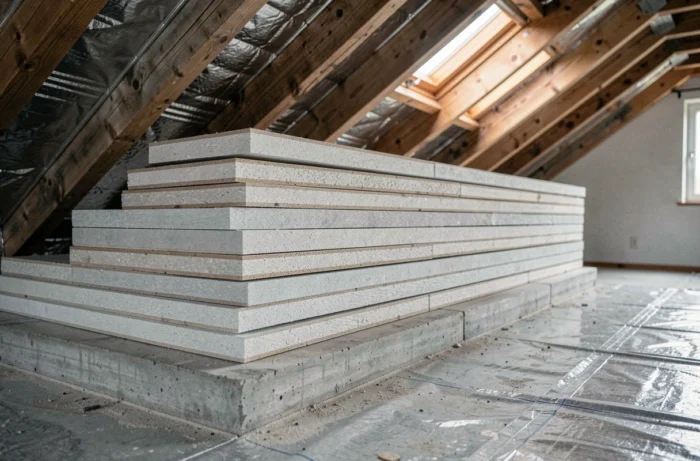
The average cost of insulating lost attics (installation included) ranges from 20 to 50 €/m², while converted attics represent a budget of 60 to 150 €/m². The gap is explained by the complexity of implementation under slopes, the need to address thermal bridges at the level of the rafters and beams, and the frequent choice of denser insulations.
Insulating attics remains the energy renovation gesture with the most measurable cost-benefit ratio: a reduction of 20 to 30% on heating bills constitutes a tangible return, often observed from the first winter. The parameter that makes the difference between an ordinary project and a truly high-performing one lies less in the thickness of insulation than in the quality of implementation, particularly the elimination of thermal bridges and the continuity of the vapor barrier.