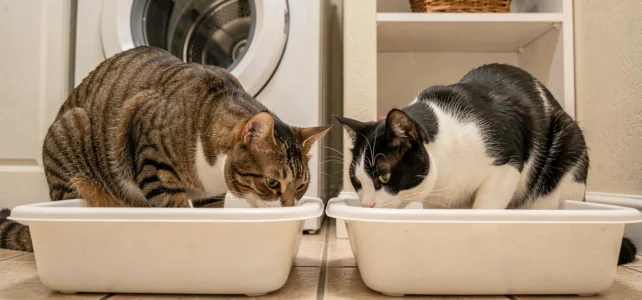
The n+1 formula is the foundation for any household welcoming multiple cats: you need to provide one litter box per cat, plus one additional box. For two cats, that means three litter boxes. This recommendation, validated by veterinary behaviorists, is based on the territorial behavior of domestic cats and their hygiene requirements.
Litter Boxes and Levels: A Constraint Not Covered by the n+1 Rule
Applying the n+1 formula without considering the layout of the home only addresses half of the problem. In a multi-level house, stairs can pose a real barrier, especially for an older cat or one suffering from arthritis.
The recommendations from the Cornell Feline Health Center and the ASPCA support this: there should be at least one litter box per floor frequented by the cats, in addition to the n+1 calculation. Specifically, if two cats live in a two-level house, three boxes remain the minimum, but their distribution is just as important as their number.
A cat that has to go down a staircase to access its only box in the basement will eventually find a more accessible alternative, often a rug or a corner of the hallway. Knowing how many litter boxes for 2 cats is not enough if these boxes are all grouped in the same room.
Litter, Water, and Food Triptych for Two Cats
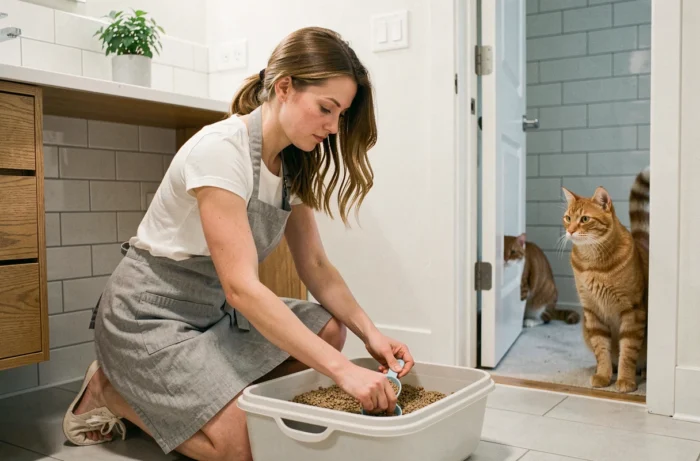
Recent enrichment plans for indoor cats expand the n+1 rule beyond just the litter box. The recommendation now covers a triptych of litter, food, and water, each following the same formula: one point per cat, plus one additional point.
For two cats, this means three litter boxes, three food points, and three water points, distributed in distinct areas of the home. The goal is to reduce competition among peers for each resource.
Why Separating Resources Reduces Stress
A cat that eats next to its litter box may develop an aversion to one or the other. Similarly, a subordinate cat that has to pass by the dominant cat’s food bowl to access water will end up drinking less, which can lead to urinary problems.
Dispersing resources across multiple rooms allows each cat to eat, drink, and relieve itself without constantly encountering the other. Reducing crossing points decreases silent conflicts, those tensions that manifest neither through scratches nor hissing, but through avoidance, urine marking, or gradual uncleanliness.
Cat Uncleanliness: When the Number of Boxes Is Not the Problem
A study conducted by Hartpury University and published in August 2026 identifies multiple factors contributing to uncleanliness in domestic cats. The number of boxes is just one parameter among others. The type of substrate, location, cleaning frequency, and overall stress level in the household weigh just as heavily.
Adding a third box will not solve anything if all three are placed side by side in the laundry room, cleaned once a week, and filled with a scented litter that one of the two cats refuses.
Criteria to Check Before Adding a Box
- The substrate: some cats prefer clumping clay litter, while others prefer plant-based litter. Testing two different types in two boxes can help identify each animal’s preference.
- Cleaning frequency: removing waste at least once a day is the threshold below which a demanding cat will start to avoid its box.
- Location: a box in a busy hallway or next to a washing machine will be neglected. Favor quiet areas, accessible at all times, with a visible exit route for the cat.
- The type of box: a closed box retains odors and can generate aversion. For a household with two cats, open and sufficiently large boxes facilitate use by both animals.
Self-Cleaning Litter Box for Two Cats: Real Gain or False Solution
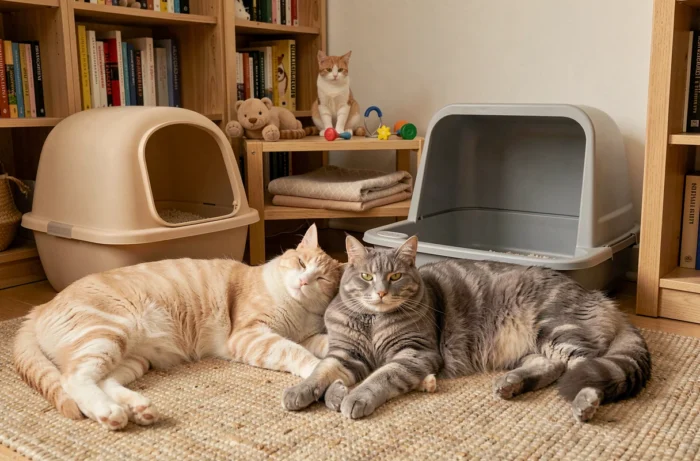
Self-cleaning boxes appeal to owners of multiple cats with their promise of automated cleaning and odor control. The mechanism scrapes or sifts the substrate after each use, keeping the box clean for longer.
For a household with two cats, a self-cleaning box can replace one or two traditional boxes in terms of cleanliness perceived by the cat. The substrate remains fresh between uses, reducing the risk of aversion.
Limitations to Know
A self-cleaning box does not change territorial needs. Even with a high-performing robot, a single box for two cats remains insufficient. The noise of the mechanism can also scare an anxious cat and lead to long-term avoidance.
The cost of purchase and maintenance (bags, filters, compatible substrate) far exceeds that of traditional boxes. For two cats, combining a self-cleaning box in the main room with two traditional boxes in other areas of the home is a realistic compromise.
The question of how many litter boxes for two cats is resolved by the n+1 formula, but this formula only holds value if it is accompanied by an appropriate spatial distribution within the home. Three poorly placed boxes offer less protection than one well-positioned box, and the cleanliness of the substrate remains the factor that cats are least forgiving of.