Every couple has a different story, and the wedding benefits from telling it. Organizing a unique wedding doesn’t necessarily require spectacular ideas or an extravagant budget. The starting point is to clarify what truly matters to both of you, and then translate those choices into every detail of the day, from the venue to the ceremony and the atmosphere of the reception.
Rituals for a Secular Ceremony to Anchor Your Story in Marriage
Have you ever attended a ceremony where everything seemed recited, with no connection to the couple? This is often because the chosen ritual had no relation to their experiences. Conversely, a well-chosen ritual transforms the ceremony into a moment of collective emotion.
Handfasting, for example, involves binding the couple’s hands with a colored ribbon. Each color carries a meaning (red for passion, blue for sincerity, green for prosperity). This simple gesture creates a suspended moment that guests remember for a long time.
A time capsule works on a different level. Each of the couple slips in a letter, an object, or a photo. The capsule will only be opened on a set date, five or ten years later. This ritual projects the couple into the future in front of their loved ones.
Planting a tree on the wedding day has a strong visual and symbolic effect. The tree grows with the couple. It becomes a concrete landmark, a place to return to. Couples with a garden or family land find a particular anchoring in this.
The sand ritual involves pouring two different colored sands into the same container. The grains mix and cannot be separated. It is a direct image of union. To find more ideas for rituals and personalization, a useful resource is https://www.mariageunique.fr/, which details several formats for custom ceremonies.
Personalization of the Wedding Theme and Decoration
Choosing a wedding theme does not mean slapping a Pinterest aesthetic onto your day. The most successful theme reflects a shared passion or memory. A couple of hikers might organize the reception around raw wood, topographic maps, and menus inspired by shelter recipes. A music-loving couple could structure the evening like a concert, with a displayed set list and tables named after albums.
The guiding thread then unfolds in the concrete details:
- The invitations set the tone. A seeded invitation (to be planted after reading) announces a nature-oriented wedding. A vinyl or QR code invitation leading to a playlist announces a festive atmosphere.
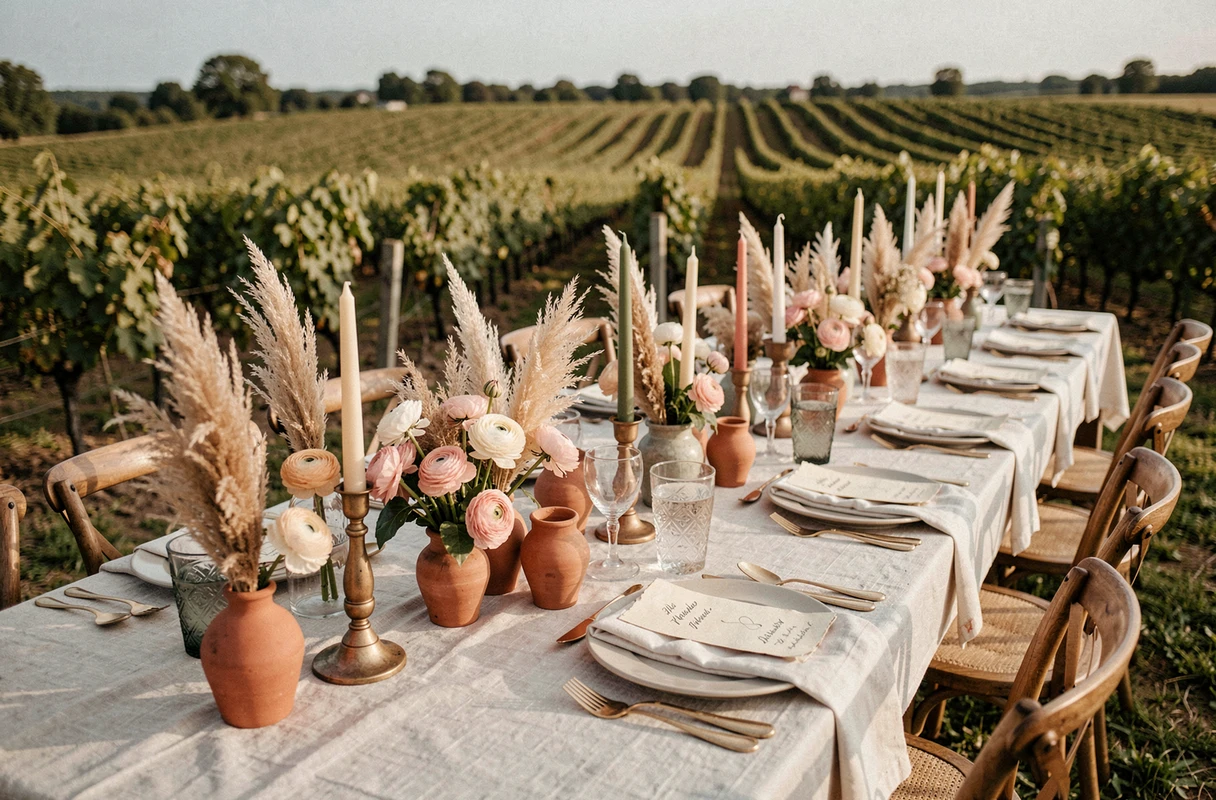
- The table decoration extends the theme without overwhelming it. Two or three coherent elements (dominant color, material, recurring object) are sufficient. Beyond that, the effect becomes artificial.
- Guest favors should be useful or edible. A small jar of local honey, a packet of seeds, or a printed recipe of the couple’s favorite dish make a stronger impression than a generic decorative item.
Consistency between the venue, theme, and details matters more than the budget invested in each item. A wedding in a barn with thoughtful, understated decoration will have more character than a luxurious reception hall decorated without a clear direction.
Participatory Activities for an Unforgettable Reception
The atmosphere of a wedding reception relies less on the number of activities than on their ability to engage the guests. Why this choice? Because an active guest retains the evening’s memories better than a passive one.
A couple quiz via phone works well during the meal. Guests answer questions about the couple’s story from their smartphones. The real-time ranking creates a light competition without interrupting the service.
Crossed video testimonials bring a surprise that is hard to match. A few weeks before the wedding, a friend collects short videos from family and friends. The montage is projected during the evening. The couple discovers messages they weren’t expecting.
A close-up magician circulates among the tables during the cocktail hour. This format avoids downtime without imposing a centralized activity. Each group of guests experiences a different moment.
Beware of a common trap: linking too many activities disrupts the rhythm instead of enhancing it. Two or three well-placed highlights during the evening are better than six overlapping activities. Leave free time for guests to chat, dance, or enjoy the venue.
Choosing the Reception Venue and Constraints to Check Before Booking
The venue sets the stage for everything else. A wedding in the forest, by a lake, or in a museum creates an atmosphere that decoration alone cannot produce. Before being seduced by an unusual setting, check a few concrete points to avoid unpleasant surprises.
- Accessibility for people with reduced mobility. A venue in the middle of nature without a passable path excludes some guests. Ask the owner before any visit.
- The actual capacity of the venue. A beautiful space that is too small for your guest list turns the reception into a waiting line. Ask for the maximum number in a meal configuration, not in a cocktail configuration.
- Included services and required vendors. Some venues require working with their caterer or DJ. Others allow total freedom but do not provide tables, dishes, or sufficient electricity.
- The logistics for the end of the evening. On-site or nearby accommodation, parking, noise allowed until what time: these details condition the actual flow of the party.
A well-chosen venue simplifies organization instead of complicating it. If you spend more time solving logistical problems than preparing the content of your day, the venue is probably not the right one.
The wedding that leaves a lasting impression is not the one that accumulates original ideas. It is the one where every choice, from the ritual to the dessert, tells the same story. Start with what reflects you, eliminate what only serves to look pretty, and focus your energy on the three or four moments that truly matter to you.