A personalized embroidered beanie relies on a chain of technical decisions, from the choice of textile to the validation of the embroidery file. Each decision alters the final appearance, the durability of the design, and the comfort of the wearer. Understanding these decisions in order helps avoid rework, additional costs, and disappointing results.
Material of the beanie: acrylic, organic cotton, or blend
The choice of textile determines everything else. Standard acrylic yarn offers elasticity and retains colors well after washing, but it retains heat unevenly. An organic cotton beanie breathes better, is suitable for mid-seasons, and meets the growing environmental information requirements imposed by the AGEC law in France.
Blends (cotton-polyester, wool-acrylic) allow for a combination of flexibility and structure. The weight is as important as the composition: a knit that is too thin deforms under the tension of the embroidery, while a thick knit limits the detail of the designs.
Before validating a material, check that the supplier can provide an embroidered sample. Knit reacts differently than flat fabric, and a satisfactory result on woven cotton does not guarantee anything on ribbed knit. Understanding the steps for a personalized embroidered beanie allows for anticipating these adjustments right from the selection of the material.
Embroidery file: vector format and knit constraints
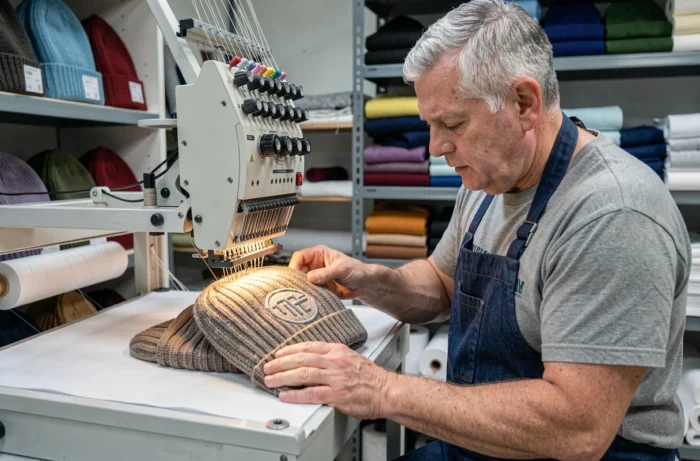
Digital embroidery does not reproduce an image pixel by pixel. It converts a vector drawing into a stitch program (DST, PES, or JEF depending on the machine). This conversion is called digitizing the design, and this is where most errors occur.
A logo designed for printing often contains gradients, drop shadows, or lines thinner than one millimeter. None of these elements translate correctly into embroidery stitches. The source file must be cleaned up before digitization:
- Convert fonts into vector curves (AI or EPS format) to avoid font substitutions when opening the file
- Remove any gradients and replace them with solid colors, as each shade corresponds to a thread change on the machine
- Maintain a minimum lettering size of about five millimeters in height to ensure each character remains legible on a knit
The number of thread colors directly impacts the embroidery time and unit cost. Each thread change adds a machine stop. Limiting the design to three or four colors maintains a good balance between visual appeal and budget.
Embroidery area on a beanie: cuff, front, or side
A beanie is not a flat surface. Embroidery must contend with curvature, the elasticity of the knit, and the fold of the cuff. The placement of the design affects its visibility and deformation during use.
The front area above the cuff is the most common: it offers the best visibility and the most stable surface. The design undergoes little deformation there, provided it remains centered and does not exceed the width of the forehead.
Embroidering on the cuff itself poses a problem of double thickness. The needle passes through two layers of knit, which stiffens the area and can create a cardboard effect if the design is dense. This option works for a small logo or short text, but not for a complex visual.

Side embroidery (temple or back) is suitable for discreet markings, such as a pictogram or initials. The curvature is more pronounced there, which distorts long horizontal lines. Prefer compact designs, in square or round shapes.
Proof approval and quality control before production
The digital proof approval (BAT) simulates the final rendering on a 3D visual or photo of the beanie. This step does not replace a physical prototype, but it allows for detecting positioning, proportion, and color errors before mass production begins.
Check three points on the BAT:
- The size of the design relative to the embroidable area (a logo that is too large overflows onto the side seams)
- The correspondence between the requested Pantone colors and the threads offered by the embroiderer, as each thread manufacturer has its own Pantone conversion table
- The orientation of the text, which must remain perfectly horizontal even if the beanie is worn slightly tilted
If you order a volume exceeding a few dozen pieces, request a physical embroidered sample before validating the full production. The on-screen rendering does not reflect the texture of the thread on the knit, nor the actual stiffness of the embroidered area.
Traceability and labeling: recent obligations for online sales
Since December 2024, the Regulation (EU) 2023/988 on the general safety of products imposes enhanced traceability for any textile accessory sold online to consumers in the European Union. The contact details of the manufacturer or market operator must appear directly on the product or its packaging, not just in the online product sheet.
A technical file must be kept for ten years, including risk assessment and batch traceability. For a personalized embroidered beanie, this means that the choice of supplier must include their ability to provide these documents upon ordering.
At the same time, the AGEC law in France continues to expand the obligations for environmental information on textile products. An embroidered beanie intended for resale must specify the exact composition of the materials, including the embroidery threads if their nature differs from the base material. Anticipating these requirements from the design stage avoids the need to re-label an entire stock after production.