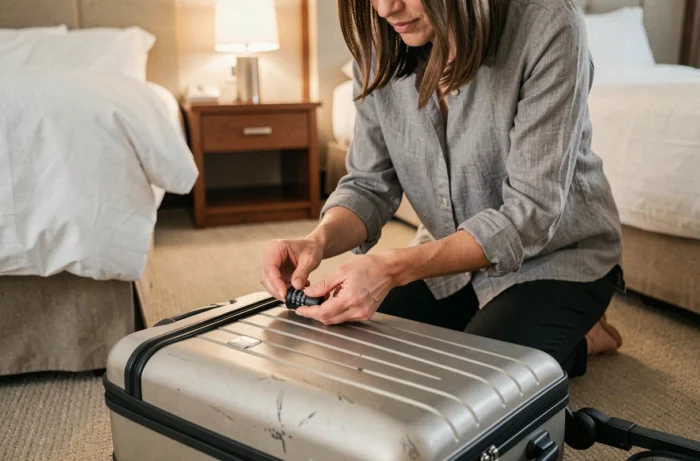
The TSA007 lock integrated into Samsonite suitcases relies on a mechanism with three dials coupled with a master key TSA reserved for U.S. customs. On recent models, the code cannot be reset without knowing the current combination. This constraint, rarely mentioned in general guides, radically changes the unlocking strategy.
Internal mechanism of the TSA007: what really prevents resetting
The TSA007 lock uses a system of notched discs aligned on a central axis. Each dial corresponds to a disc whose notch must align with the locking bar to release the latch. The reset button, accessible via a pen or a thin tool, only depresses when the active combination is already set on the dials.
This is why the classic method (pressing the reset button, choosing a new code, releasing) systematically fails when the current code is unknown. The button remains physically blocked by the misaligned discs. We regularly observe this confusion: travelers force the button at the risk of breaking the return spring, rendering the mechanism permanently unusable.
When a procedure for lost Samsonite tsa007 suitcase code describes a direct reset, it implicitly assumes that the factory code has never been changed or that the user still knows their combination.
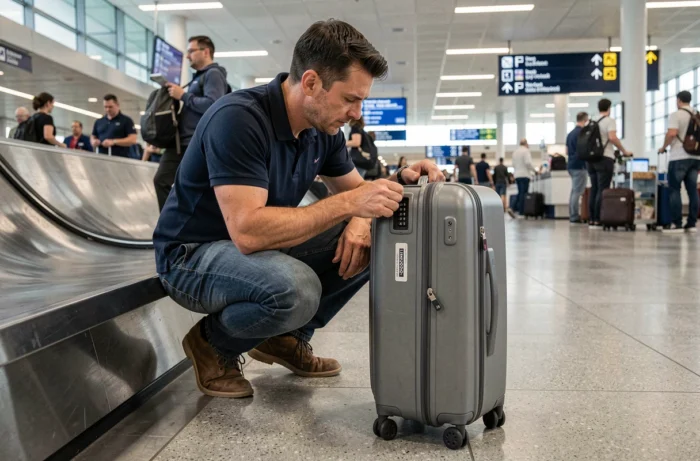
Finding the TSA007 code through tactile reading of the dials
The only realistic approach without knowing the code is to exploit the mechanical tolerances of the lock. Each notched disc has a slight play when it reaches the correct position. This technique requires patience, not force.
Powering the mechanism
Maintain constant pressure on the opening button (or gently pull on the zipper slider, depending on the model). This tension presses the locking bar against the discs and amplifies the difference in resistance between a correct position and an incorrect one.
Sequential rotation of the dials
Start with the dial closest to the locking button. Turn it slowly, digit by digit, while maintaining tension. When the correct digit passes under the marker, you will perceive a micro-click or a slight decrease in resistance. Note this digit and move on to the next dial.
- Dial 1 (next to the button): the most sensitive to tactile feedback, to be tested first
- Dial 2 (central): the mechanical play is often more subtle, slow down the rotation
- Dial 3 (end): if the first two are correct, the slider will unlock clearly at the correct digit
A complete pass through the thousand combinations rarely takes more than twenty minutes with this method. In practice, tactile reading reduces the work to a few dozen targeted attempts.
Factory code 0-0-0 and specific cases for Samsonite
Before any manipulation, we recommend testing the combination 0-0-0. This is the default factory code on almost all TSA007 Samsonite locks. If the suitcase was purchased recently and the owner has never customized the code, this combination is sufficient to open the luggage and normally access the reset button.
Some older models use a different factory code. In the absence of documentation, also test simple repetitive sequences (1-1-1, 2-2-2, etc.) that are sometimes chosen by hurried users during the initial setup.
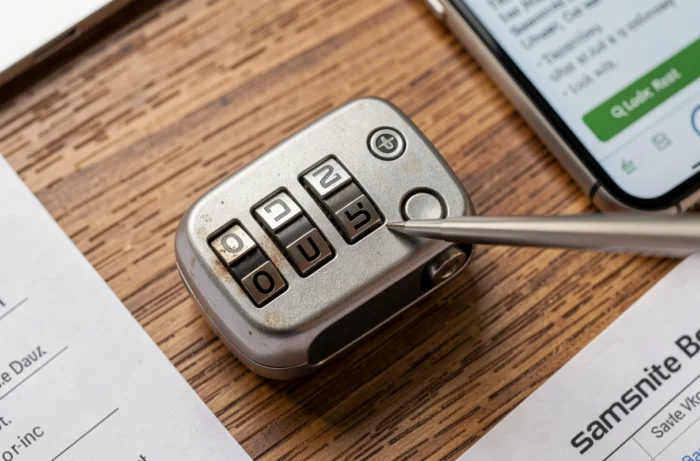
Resetting the code after unlocking the TSA007 lock
Once the combination is found and the dials are set to the correct code, the reprogramming procedure is identical across all TSA007 Samsonite models:
- Set the dials to the current code (the one you just found)
- Press the reset button with the tip of a pen until it clicks: it must remain pressed
- Turn each dial to the desired new code, then release the reset button
- Immediately test the new code by locking and then unlocking the suitcase before closing it
Never close the suitcase without having verified the new code at least twice. A reset button that is improperly released can freeze the mechanism on an intermediate combination, and the problem starts all over again.
Professional recourse: authorized Samsonite dealer or locksmith
If tactile reading yields no results (mechanism too tight, worn dials, damaged return spring), Samsonite’s official position points to two channels. The first: go to an authorized Samsonite store or dealer, where the staff has specific tools to unlock and reprogram the lock without damaging the luggage shell.
The second: send the suitcase to a partner service center, with proof of purchase, for an intervention covered by the manufacturer’s warranty if the luggage is still eligible. This option remains the only guarantee of preserving the integrity of the TSA mechanism.
Calling a general locksmith also works, but few locksmiths master the specifics of TSA locking. The main risk is forcing that damages the plastic housing integrated into the shell, making lock replacement mandatory.
The TSA007 lock remains a seemingly simple mechanism, but its reset logic traps the majority of users. Testing 0-0-0, applying tactile reading under tension, then properly reprogramming the code: this sequence resolves the vast majority of cases without tools or external intervention. For situations where the mechanism resists, going through an authorized Samsonite service point prevents a simple code forgetfulness from turning into unusable luggage.