
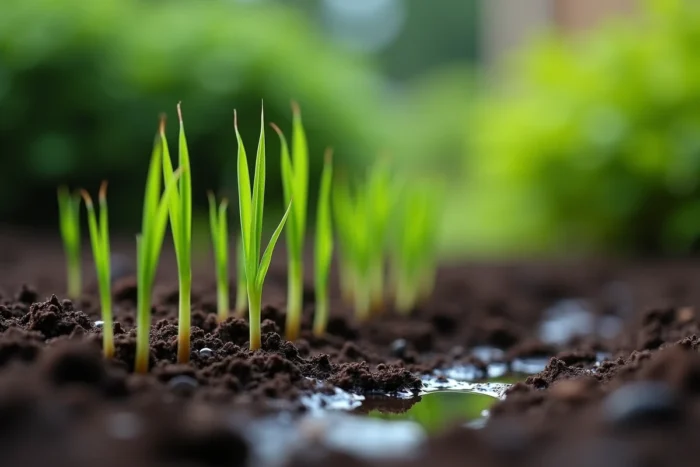
The germination of a grass seed depends on two physical parameters: soil temperature and its moisture level. Below a certain heat threshold, the seed remains dormant. Beyond a certain level of dryness, the germ dies before it can root. Choosing the right time to sow grass therefore involves identifying the window where these two conditions overlap for as long as possible.
Soil Temperature and Germination: The Threshold to Watch
Cool-season grasses (ryegrass, fescue, bluegrass) need a soil temperature stabilized above 10 °C to initiate germination. It is not the air temperature that matters, but the temperature measured a few centimeters below the surface.
In spring, the soil warms up more slowly than the ambient air. An afternoon at 18 °C does not mean that the ground has shed its winter chill. In autumn, the phenomenon reverses: the soil retains the heat accumulated during the summer, even when nights become cooler.
This thermal inertia explains why identifying the ideal time to sow grass is not just about reading a calendar. The texture of the ground also plays a role: sandy soil warms up quickly but cools down just as fast, while clayey soil accumulates heat with a delay and releases it for a long time.

Grass Sowing in Autumn or Spring: Two Different Logics
Both autumn and spring offer a favorable window, but for different reasons.
Autumn, a Head Start on Weeds
Between mid-September and the end of October (depending on the regions), the soil is still warm and rainfall resumes. Seeds germinate quickly, and young shoots benefit from several weeks of growth before the cold sets in.
The often underestimated advantage of this period lies in the reduced competition with weeds. Most annual weeds complete their vegetative cycle in autumn. The grass establishes itself in an area where competitive pressure is low, which promotes dense rooting before the following spring.
Spring, Under Strict Conditions
Spring sowing works, but the window is narrower. The soil must have reached its temperature threshold, which often delays sowing until April in the northern half of France. At the same time, weeds also start to grow, and competition for light and nutrients is direct.
Spring sowing requires more rigorous watering if May turns out to be dry. In autumn, morning dew and natural rains take care of part of the work.
Warm-Season Grasses: A Third Sowing Window
The classic distinction between autumn and spring concerns the so-called “cool-season” grasses (fescue, ryegrass, bluegrass). Another category exists: warm-season grasses, such as Cynodon dactylon (Bermudagrass).
These varieties germinate and establish themselves when the soil exceeds the threshold for classic grasses. Their sowing window is in late spring or early summer, precisely the period when traditional grasses suffer the most. Once established, these lawns consume much less water and remain green during heat waves.
This option changes the usual logic of “never in summer.” For Mediterranean regions or south-facing gardens, a C4 grass sown in June can yield better results than ryegrass sown in September and scorched the following summer.
- Cool-season grasses (fescue, ryegrass, bluegrass): ideal sowing from mid-September to the end of October, or in April-May if the soil is sufficiently warmed.
- Warm-season grasses (Cynodon dactylon): sowing from late May to early July, with well-warmed soil and no risk of residual frost.
- Overseeding on an existing lawn: mid-September to the end of October for a lasting result, as young shoots benefit from autumn moisture without facing summer competition.
Preparing the Soil Before Sowing: What Conditions the Germination
The chosen period does not compensate for poorly prepared soil. Two steps determine the success of sowing, regardless of the season.
Leveling and Refining the Surface
A coarse soil, with compact clods, prevents contact between the seed and the substrate. Seeds remain on the surface, exposed to wind and birds. A pass with a harrow or rake to break the clods and achieve a fine and even soil significantly improves the germination rate.
Firming Without Compacting
After sowing, a light rolling presses the seeds against the moist soil. The trap would be to compact a heavy clay soil too much: water stagnates, and seeds rot. On sandy soil, rolling is more effective as drainage remains naturally good.
Surface moisture must be kept constant during the first two to three weeks. Soil that alternates between waterlogged and dry leads to irregular germination and sparse areas that are difficult to recover.
Adapting the Sowing Period to One’s Region
France presents significant climatic differences between the north and south, between the Atlantic coast and continental areas. An autumn sowing that works perfectly in Île-de-France may fail in the Alps if frost arrives too early.
- Northern half and continental areas: prioritize September, or early October at the latest, to give the grass time to root before the first frosts.
- Atlantic coast: the prolonged autumn warmth allows sowing until mid-October, sometimes late October in a mild year.
- Mediterranean regions: autumn remains relevant for traditional grasses, but warm-season varieties offer a real summer alternative due to their drought tolerance.
The choice of the sowing period for grass relies on a cross-reading of soil temperature, grass type, and local climate. A sowing timed according to these three parameters germinates faster, roots better, and withstands the first water or heat stresses it encounters.