
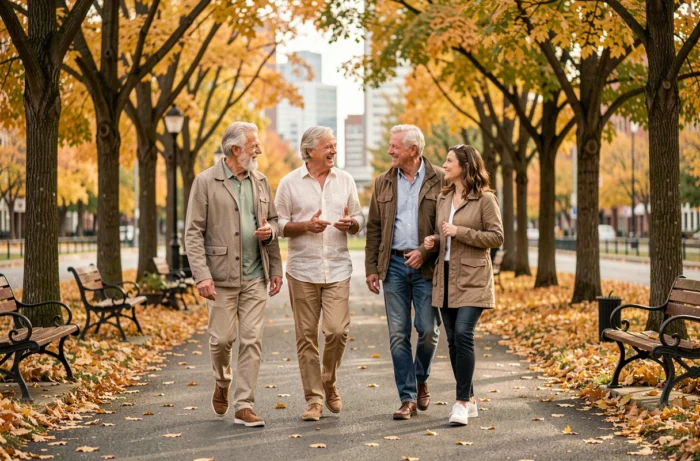
After 50, the social circle often contracts without one realizing it. Children leaving home, retirement, geographical distance from former colleagues: the opportunities to regularly meet the same people decrease.
In June 2025, the WHO recognized social connections as a major public health determinant, which places the issue of late friendships on both a medical and personal level. What concrete levers work to rebuild a friendship network after fifty, and which ones are overestimated?
1. Intergenerational cohabitation to break daily isolation
Sharing your home with a younger person (student, young professional) creates a structured daily contact that depends neither on a schedule nor on a temporary motivation. The principle is based on an exchange: a moderate rent in exchange for regular presence and some services.
This arrangement does not always produce a friendship in the classical sense, but it restores a framework of repeated micro-interactions. And it is precisely this informal repetition that is lacking after 50. Intergenerational cohabitation acts as a relational safety net, especially for those living alone in a home that has become too large.
Several local associations connect homeowners and candidates. The selection filter focuses as much on lifestyle compatibility as on rent, which distinguishes this format from simple shared housing.
2. Regular volunteering in a local organization
Volunteering remains one of the few frameworks where you meet the same people each week, with a shared goal. This is exactly the combination that allowed friendships to form in school or at work. After 50, it reproduces these conditions without requiring any particular social skills.
For volunteering to generate lasting connections, it is essential to meet people on Green Seniors or in associations where the activity requires cooperation (outreach, food distribution, sports coaching) rather than solitary tasks like administrative sorting.
Weekly regularity matters more than the volume of hours. Two hours every Wednesday create more connections than a full day once a month, because familiarity is built through frequency.
3. Collective physical activity on a fixed schedule
Nordic walking, aquagym, indoor yoga, club hiking: these activities share a common point that is often underestimated. They impose a recurring physical appointment with the same group. Moving bodies reduce social awkwardness because attention is focused on the effort rather than on conversation.
Team sports after 50 impact social connections and health simultaneously. Practicing together enhances motivation and creates opportunities for informal exchanges before and after the session.
In contrast, individual fitness classes (machines, treadmills) offer virtually no interaction. The selection criterion is not the sport itself, but the collective format on a fixed schedule.
4. Creative or cultural workshops in small groups
Pottery classes, writing workshops, choirs, book clubs: these formats work because they combine three ingredients favorable to adult friendships.
- A small group size (usually fewer than fifteen people), which allows for remembering names by the second session
- A shared activity that provides a natural conversation topic, without the effort of “small talk”
- A common progression that creates a sense of belonging over the weeks
The choir stands out particularly. Singing together synchronizes physiological rhythms and produces a measurable group cohesion effect, even among strangers. For those who find initial conversations difficult, it is a format where the connection is created through activity before moving to words.
5. Reactivating dormant connections before seeking new ones
Before multiplying registrations, an inventory of existing but inactive relationships often proves more fruitful. An old colleague, a neighborhood acquaintance lost sight of, a friend of a friend met at a dinner two years ago: these dormant connections are easier to reactivate than building a new one.
A simple message that recalls a specific memory works better than a generic “we should meet up.” The specificity of the message signals genuine interest. Most people do not follow up for fear of bothering, while research in social psychology regularly shows that recipients appreciate the contact more than the sender anticipates.
This step requires no stepping out of one’s social comfort zone. It only takes twenty minutes to browse through your phone contacts with a fresh perspective.
6. Digital platforms dedicated to outings for seniors
Several French-speaking platforms offer group outings organized by age group or interest. Their added value compared to general social networks lies in one specific point: they convert online contact into scheduled physical meetings.
| Criterion | General social network | Seniors’ outing platform |
|---|---|---|
| Main objective | Maintain existing connections | Create new connections through activity |
| Transition to reality | Rare, depends on individual initiative | Integrated (scheduled events) |
| Age filtering | Absent | Present |
| Risk of remaining passive | High (scrolling without interaction) | Low (registration for a concrete event) |
The main trap remains consulting these platforms without ever validating a registration. The act of registering takes place within 48 hours of discovering an event: beyond that, the likelihood of signing up drops significantly.
7. Request for social connection hours in the APA aid plan
This lever specifically concerns individuals experiencing a loss of autonomy benefiting from the personalized autonomy allowance (APA) at home. Since January 1, 2024, the APA aid plan can include up to nine monthly hours dedicated to social connections, as outlined in the Social Action and Families Code.
Concretely, this means that a professional can accompany the person on outings, visits, or collective activities, with funding from the departmental council. The regulatory rollout began in 2025, and not all departments apply the system in the same way yet.
To benefit from it, one must explicitly request it during the assessment of the aid plan. This right remains little known, even among support professionals. Mentioning it to one’s APA referent or the departmental medico-social team is enough to trigger the evaluation.
Expanding one’s social circle after 50 does not rely on an innate relational quality. The seven levers described here share a common trait: they artificially recreate the conditions of repetition and proximity that fostered friendships earlier in life. The most determining factor is not the choice of lever, but the regularity with which one adheres to it.