
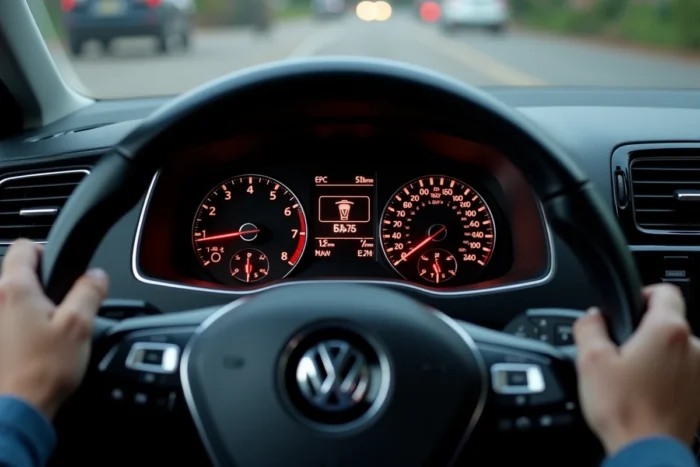
The EPC (Electronic Power Control) warning light indicates a fault in the engine’s electronic management. This orange light is specific to vehicles from the Volkswagen group, which includes Volkswagen Polo, Audi A1, A3, or A4, as well as Seat and Skoda. Its activation usually triggers a limp mode, limiting engine power to prevent mechanical damage.
Electrical voltages and CAN bus: the causes that standard diagnostics miss
Most guides on the EPC warning light immediately point to the accelerator pedal sensor or the throttle body. These leads are valid, but they overlook two causes that have been on the rise in recent years.
The first concerns unstable battery voltages or a worn alternator. On recent Audis (MQB and MLB platforms), workshop feedback has reported since 2023-2024 that the control unit preemptively cuts certain functions (power steering, ESP, brake assist) as soon as the electrical voltage fluctuates, even before a starting issue manifests. The EPC light then plays a role as an electrical pre-alert, not a strict engine failure signal.
A detailed article on the EPC warning light on Audi and Polo lists the most common scenarios, including those related to the electrical circuit.
The second cause concerns communication losses on the CAN bus. On Volkswagen Polos, garages have noted since 2022 an increase in intermittent EPC warnings related to aging wiring and connectors. The light briefly illuminates, sometimes without any other symptoms, and then disappears. These cases often resolve with a check and reattachment of grounds and connectors, without sensor replacement.
Throttle body fouling: the link with modern fuels
A fouled throttle body is mentioned in all articles on the subject. What is often missing is the explanation of the mechanism that accelerates this fouling.
Since the widespread use of fuels containing ethanol (E10, or even E20 or E25 in some countries), deposits on the throttle body form more quickly, especially on gasoline direct injection engines in the VW and Audi ranges. Ethanol alters the air/fuel ratio and promotes the condensation of residues in the intake circuit.
Short trips exacerbate the phenomenon. An engine that never reaches its optimal operating temperature does not burn off these residues. The throttle gradually loses its range of motion, the control unit detects a discrepancy between the requested position and the actual position, and the EPC light comes on.
Cleaning or replacing the throttle body
In most cases, cleaning the throttle body with an appropriate product is sufficient. After the operation, a reset of the throttle adaptation via the diagnostic tool is necessary for the control unit to relearn the limits. Without this step, the light may reappear immediately.
If cleaning does not resolve the issue, the throttle body itself may be defective (stuck internal electric motor or worn potentiometer). In this case, replacing the part is necessary.
Accelerator pedal sensor and brake sensor: two parts not to confuse
The accelerator pedal position sensor is the most documented cause of an EPC warning light. It transmits the driver’s intention to the control unit. When this sensor sends an inconsistent signal, the system cuts power for safety.
Typical symptoms of a faulty accelerator sensor:
- Sudden loss of power, the engine no longer responds to the pedal being pressed
- Jerkiness in acceleration, with engine speed rising and falling erratically
- EPC light accompanied by the engine light (both lights illuminate simultaneously)
The brake light sensor is a less known but common cause. On Volkswagen group vehicles, this sensor is part of the electronic control chain of the engine. A faulty brake sensor can trigger the EPC light without any apparent link to braking, which confuses many drivers.
OBD2 diagnostics of the EPC warning light: reading fault codes
The EPC light does not specify the nature of the malfunction. Only a diagnostic via an OBD2 port can identify the exact fault code recorded by the control unit.
Some pointers for properly utilizing a diagnostic:
- Fault codes P0120 to P0124 point to the throttle position sensor
- Codes P2135 or P2138 concern the correlation between the accelerator pedal sensors
- A U code (network) indicates a communication problem on the CAN bus, not an isolated sensor fault
- A cleared code without repair will return, often within a few kilometers
Clearing a fault code without addressing the cause is pointless. The control unit will rewrite the fault as soon as it detects it again. This operation only serves to check if a fault is intermittent (for example, after cleaning the throttle) or persistent.

Limp mode and driving: what happens in practice
When the EPC light triggers limp mode, the control unit deliberately restricts engine power. The vehicle remains drivable, but accelerations become very slow. The maximum speed may drop to a level that makes highway driving impossible.
Continuing to drive in limp mode for a short distance to reach a garage usually does not pose any additional mechanical problems. Ignoring the light for weeks, however, can turn a moderately costly sensor fault into a much heavier engine control unit repair.
The EPC light that comes on briefly during startup and then goes off corresponds to the system’s automatic test. This behavior is normal. The signal that should alert you is a light that stays on while the engine is running or appears during driving.