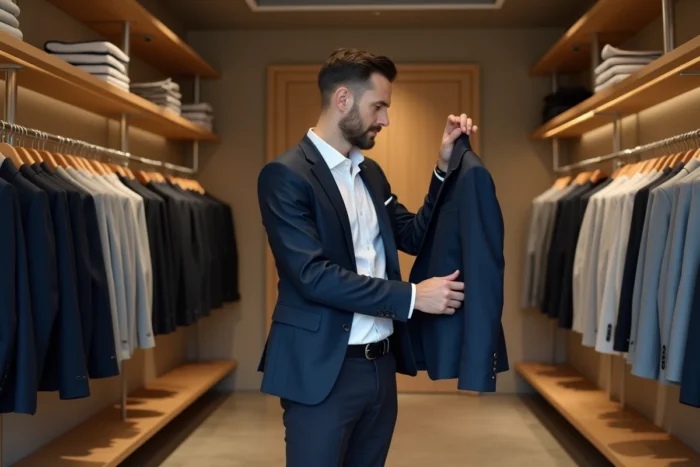
Choosing men’s clothing is not just about following a list of basics. Body shape, lifestyle, and recent changes in cuts alter the game for anyone looking to create a coherent wardrobe. The market offers more varied silhouettes than a few years ago, with the return of loose cuts and the rise of minimalist wardrobes, complicating as much as enriching the choice.
Taking measurements before buying: the prerequisite that most guides overlook
Many men buy based solely on the size displayed on the label (S, M, L or 38, 40, 42). The problem is that these standards vary from brand to brand, sometimes by several centimeters on the same chest measurement.
Before any shopping session, three measurements are enough to avoid mistakes: chest circumference, waist circumference, and hip circumference. These data allow one to identify their morphological category (rectangle, triangle, inverted triangle, hourglass) and guide each choice of cut.
A man with a V-shaped silhouette (broad shoulders, slim waist) has no interest in wearing a straight shirt that hides his structure. Conversely, a rounder silhouette benefits from slightly fitted clothing rather than overly tight cuts that highlight what one prefers to downplay. The right cut depends on three measurements, not a universal size.
To delve deeper into this approach, Must Paris’s fashion advice details how to adapt each piece to one’s actual morphology.
Loose cuts and unstructured tailoring: what changes in choosing a good cut
For years, the unwritten rule of the men’s wardrobe could be summed up in one word: slim. Fitted shirts, slim jeans, body-hugging suits. Recent trends are overturning this logic.

The 2025-2026 collections highlight wider pleated trousers, relaxed jackets with less structured shoulders, and generally bulkier silhouettes. This movement changes the very definition of “well-cut”: a loose garment can fit perfectly if it respects the body’s anchor points (shoulders, waist, sleeve length).
In practical terms, this means that straight or slightly flared trousers are no longer a sign of negligence. Field feedback varies on this point: some body types gain in appearance with these volumes, while others lose silhouette clarity. A tall, slender man can pull off an oversized unstructured jacket well. A stockier man risks disappearing under the fabric.
The criterion remains the same as with slim: the shoulder seam must fall in the right place, and the garment should neither sag nor pull. The cut has changed, but the fundamentals of fit have not.
Capsule wardrobe for men: reducing volume without losing style
The capsule wardrobe trend involves intentionally limiting one’s closet to a small number of pieces that can be mixed and matched. Recommendations revolve around a maximum of ten to thirty interchangeable garments.
The interest goes beyond aesthetic minimalism. Fewer pieces force better selection: each garment must work with at least three others. This encourages thinking in terms of color palettes and style compatibility rather than accumulating isolated favorites.
- Start with a base of neutral colors (navy, gray, white, beige) that combine effortlessly, then add one or two accent shades
- Favor materials that transition through seasons, like a thick cotton chino that can be worn from spring to fall, or raw denim that ages beautifully
- Eliminate duplicates: two identical white shirts add nothing, while a white shirt and a sky blue shirt cover two different registers
A well-constructed capsule wardrobe makes each outfit more coherent because it eliminates orphan pieces, those that are never worn due to a lack of pairing options.
Adapting your wardrobe to your actual lifestyle
Style guides list so-called essential pieces: suit, raw jeans, white shirt, leather shoes. The problem with these lists is that they ignore each person’s daily reality.
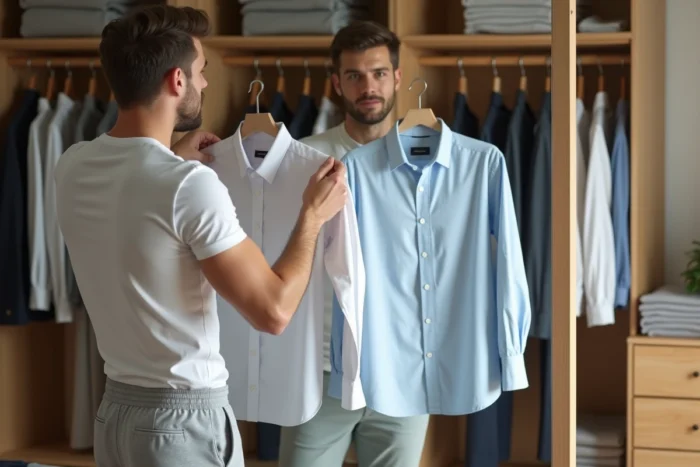
A man who works in an office with a strict dress code does not have the same needs as a freelancer working from home. The former will make the most of a well-cut suit and several shirts. The latter may never wear one and would be better off investing in quality casual pieces.
The most reliable method is to analyze one’s typical weeks:
- How many days require formal attire (suit, shirt, dress shoes)?
- How many days are spent in casual wear (jeans, t-shirt, sneakers)?
- What portion of the budget goes to weekend clothing compared to weekday clothing?
Buying based on actual usage avoids accumulating unworn pieces. A linen blazer can replace a full suit for a freelancer who occasionally meets clients. A good dark jean transitions from casual office to restaurant without a hitch.
Materials and quality: what distinguishes a sustainable purchase
The choice of material affects the longevity of the garment as much as its comfort. A cotton t-shirt with a sufficiently dense weight retains its shape after dozens of washes. A thin t-shirt distorts within weeks.
For shirts, a double-twisted cotton offers better structure and a sharper drape than a low-quality fabric. For trousers, a cotton twill chino withstands wear better than a synthetic fabric that pills. Merino wool, for sweaters, regulates temperature and limits odors, making it suitable for multiple seasons.
The available data does not allow for setting a universal price threshold below which quality would be systematically insufficient. However, a reliable indicator remains the fabric’s weight to the touch and the regularity of the seams: clean finishes on the inside of the garment (flat-felled seams, neat buttonholes) generally indicate a higher level of craftsmanship.
Choosing men’s clothing is based on three concrete pillars: knowing one’s morphology through measurement, adapting purchases to one’s actual daily life, and checking the quality of materials before looking at the brand label. The most effective wardrobe is the one that works every day, not the one that impresses in a photo.