Adopting a long-haired dachshund involves choosing between three pathways with very different guarantees, costs, and risks. Shelter, professional breeding, or private individuals: each option entails a budget, a level of health traceability, and a distinct legal framework. Comparing these factual parameters allows for an informed choice.
Shelter, breeding, and private individuals: a comparison of dachshund adoption pathways
The data available for 2024-2025 shows significant differences across the three criteria that weigh most heavily in the decision: price, health guarantees, and legal framework.
| Criterion | Shelter or association | Professional breeding (LOF) | Private individual (single litter) |
|---|---|---|---|
| Acquisition cost | Variable adoption fees (often a few hundred euros) | €1,200 to €1,800 for a long-haired LOF puppy | Variable, no defined range |
| Health tests back/genetics | Shelter veterinary assessment, sometimes incomplete history | Tests for back problems and, if applicable, the merle gene | Rarely documented |
| Regulatory obligation | Declared structure, DDPP | ACACED, SIRET, DDPP declaration 30 days before activity | Exemption if only one LOF litter per year |
| Age of available dog | Mostly adults or seniors | Puppies (minimum 8 weeks) | Puppies or young adults |
| LOF registration | Rare | Yes, systematic | Possible if parents are confirmed LOF |
The professional breeding pathway offers the most comprehensive guarantees, but also the highest price. A specialized site on long-haired miniature dachshunds publishes an average price of €1,465 for a LOF puppy, with significant variation depending on lineage and health tests conducted.
Those wishing to adopt a long-haired dachshund with Chiens et Chats will find an overview of the different pathways and their respective requirements.
Legal obligations of dog breeders: what has changed recently
The French regulatory framework has tightened its requirements for anyone breeding dogs professionally. Since the 2024-2026 period, opening a dog breeding operation systematically requires an ACACED qualification (certificate of knowledge for companion animals of domestic species), a SIRET registration via the INPI Single Window, and a declaration to the DDPP at least thirty days before starting operations.
Depending on the number of dogs present simultaneously in the structure, an ICPE regime (classified installations for environmental protection) may also apply. This additional regulatory layer mainly concerns medium to large-sized breeding operations.
The case of the private individual with one litter per year
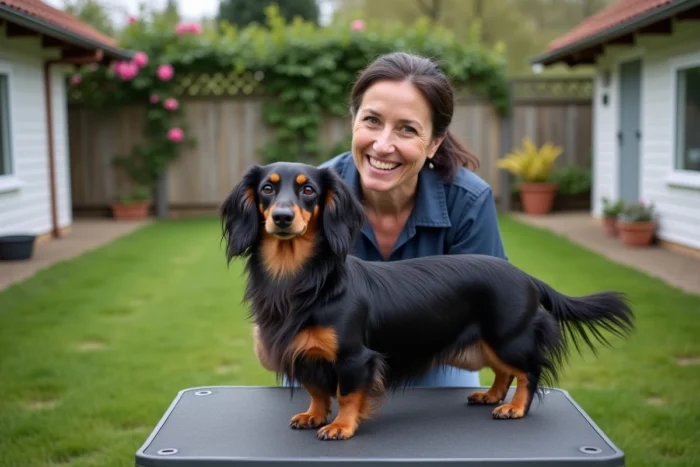
A very regulated exemption exists: a private individual can sell puppies from a single LOF litter per year without being subject to all of these professional obligations. However, as soon as a private individual produces more than one annual litter or sells non-LOF puppies for compensation, they fall into the breeder status and must comply with the same rules.
The gap between these two statuses explains why some advertisements for long-haired dachshunds between private individuals show lower prices: the absence of a declared structure reduces costs, but also health checks and genetic traceability.
Health of the long-haired dachshund: tests that justify the price difference
The dachshund, regardless of its size, remains predisposed to intervertebral disc disease (IVDD). Litters from serious breeders undergo specific tests for back problems, sometimes supplemented by screening for the merle gene for harlequin coats.
The recent pressure on the prices of long-haired LOF dachshunds is partly explained by the rarity of well-tested litters for these pathologies. Miniature and kaninchen sizes are particularly affected: their small size amplifies the vertebral risk, and lines whose breeders have been X-rayed are priced higher.
- In shelters, the entry veterinary assessment covers vaccinations, identification, and sterilization, but the dog’s orthopedic or genetic history often remains unknown.
- At a professional breeder, the health test results of the parents (back, eyes, merle gene if applicable) must be available upon request.
- For a private individual, the completion of these tests depends entirely on the goodwill of the seller, with no obligation to provide them.
An adopter who prioritizes a puppy without verified history takes a financial risk in the medium term: the costs associated with a disc herniation in a dachshund represent a significant veterinary expense.
Adult profile in a shelter or puppy in breeding: two distinct adoption logics

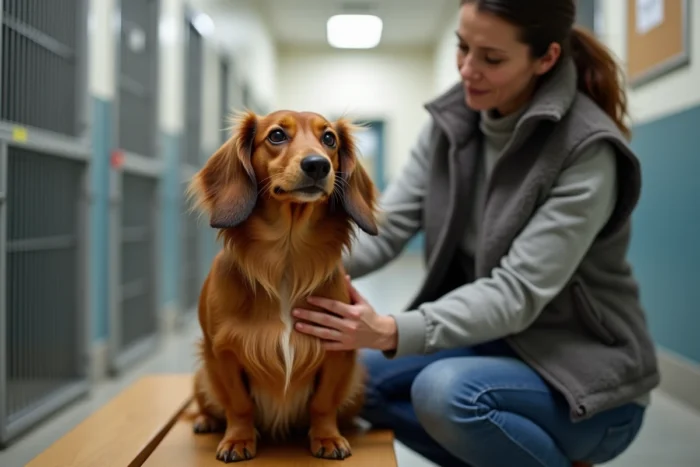
Shelters primarily offer adult or senior dachshunds. This profile has an advantage rarely mentioned in general guides: the dog’s temperament is already known. The shelter team can indicate its sociability level, tolerance to children, and reactivity towards other animals.
An eight-week-old puppy from breeding, on the other hand, remains a projection. Socialization in the early weeks conditions its future behavior, and the long-haired dachshund, known for its strong character, requires a coherent educational framework from the start.
Education and socialization of the dachshund: a factor not to be underestimated
The dachshund has been selected for centuries as an independent hunting dog. This independence translates into a tendency to test limits and bark. A early socialization program significantly reduces excessive guarding behaviors. Serious breeders start this work before the puppy is handed over, which serves as an additional argument in favor of a professional pathway.
For an adult from a shelter, the question arises differently: the educational past is not always documented, but the current behavior is observable. It is a trade-off between immediate predictability and long-term shaping potential.
The choice between shelter, breeding, and private individual ultimately rests on three measurable variables: the available budget, the required level of health traceability, and the tolerance for behavioral risk. A well-tested long-haired LOF puppy costs significantly more than an adoption from a shelter, but the health and lineage guarantees are not comparable. Conversely, an adult dachshund from a shelter offers behavioral clarity that no eight-week-old puppy can provide.