
A colleague picks up a diesel sedan at a good price on a peer-to-peer platform, signs on the same day, and then discovers a weight penalty during re-registration. Another is hesitating between a new hybrid SUV and a used electric model whose battery already shows several tens of thousands of kilometers.
These situations are encountered every week. Buying a used or new car in 2026 requires mastering some fiscal, technical, and contractual mechanics that are not mentioned in the ads.
CO2 penalty and weight penalty on an imported used car: the fiscal trap to anticipate
When buying a used vehicle from abroad, one often thinks they have avoided the ecological penalty since the car has already been registered. In practice, an imported used car is still subject to the penalty upon its first registration in France. The CO2 penalty and the weight penalty apply just like on a new vehicle, with a scale recalculated according to the year of first registration.
This regulatory point is rarely detailed in standard buying guides. It is discovered at the prefecture counter or on the ANTS website, sometimes after signing. Before concluding a cross-border purchase, one must simulate the total registration cost by including these two penalties. A gasoline SUV weighing over 1.8 tons purchased in Germany or Belgium can generate a tax bill that cancels out the savings made on the purchase price.
To calmly compare the offers available on the Swiss market, one can check the cars offered by Ct Automobiles and verify the technical specifications before initiating any import process.

Used electric car: why the market is shifting now
Diesel is clearly declining in the used car market, while transactions of used electric cars are visibly increasing in 2026. This shift in the energy mix changes the game for buyers.
Rapid depreciation and easier access
The first electric models released between 2019 and 2022 are now flooding the secondary market. Their initial depreciation, more pronounced than that of an equivalent gasoline model, makes used electric cars accessible to average budgets. Electric city cars are now available at prices comparable to those of a recent Peugeot 208 gasoline.
The point of caution remains the battery. Feedback varies on this point: some vehicles retain more than 80% capacity after several years, while others show faster degradation depending on charging conditions. Requesting the battery health certificate (SOH) from the seller is the only way to objectify the situation.
Purchase aids: a framework that has changed logic
Public support for buying a new electric car evolved in 2025. The ecological bonus was replaced by a grant funded through energy savings certificates. In practice, the amount of aid now depends on the supplier or the signing company that one approaches, not just on the chosen model.
For a new purchase, one must therefore compare the offers from several distributors before signing, as the difference in grants can reach several hundred euros on the same vehicle. For used electric cars, the schemes remain more limited and vary according to local authorities.
Technical inspection and documents: checks that truly protect
Buying guides often list about ten points to check. In practice, three checks concentrate the majority of post-purchase disputes.
- The technical inspection report of less than six months: mandatory for any sale between individuals, it must be provided before signing. Check that the chassis number on the report matches the one engraved on the vehicle, not just the one on the registration document.
- The complete maintenance history: invoices, stamped service books, dealership visits. A vehicle without traceable history loses value and exposes one to unforeseen repairs on the distribution or braking system.
- The non-pledge certificate (or administrative situation certificate): free on the ANTS website, it confirms that the vehicle is not pledged and that no opposition blocks the sale. Never rely solely on the seller’s statement on this point.
At a professional dealership, regulatory labeling must be affixed to the vehicle with the commercial designation, mileage, total price including tax, and year of first registration. The absence of this display is a warning sign.
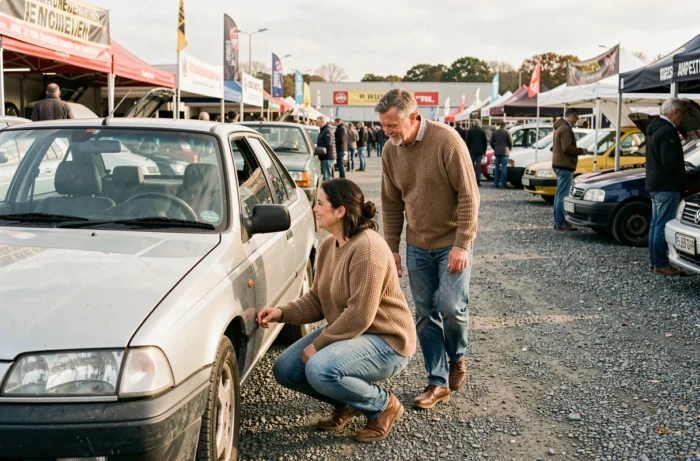
SUV, city car, or hybrid: choosing a model suited to actual use
One often overestimates their needs. An SUV seems reassuring for family trips, but its maintenance costs, fuel consumption, and exposure to the weight penalty make it an expensive choice if the main use remains the home-work commute in an urban area.
For daily use of less than 40 kilometers, a city electric car or a non-rechargeable hybrid covers most needs without extra fuel costs or constraints related to low-emission zones (ZFE). Hybrid models from Peugeot, Renault, or Toyota remain among the most reliable on the used market, with a good supply of spare parts and controlled repair costs.
For regular long trips or transporting equipment, a recent diesel minivan or station wagon (Euro 6d standard) remains relevant, provided that its compatibility with the ZFE restrictions in your driving area is verified.
- Daily urban use: electric city car or hybrid, reduced maintenance budget
- Mixed use (city + road): plug-in hybrid compact, versatility and contained consumption
- Intensive road use: Euro 6d diesel sedan or station wagon, still competitive cost per kilometer
- Occasional family use: check if a used minivan is cheaper than a new SUV with equivalent trim
The choice of model conditions the total budget over three to five years much more than the initial purchase price. Including insurance, registration, maintenance, and fuel costs in the comparison helps avoid unpleasant surprises once the signature is done.