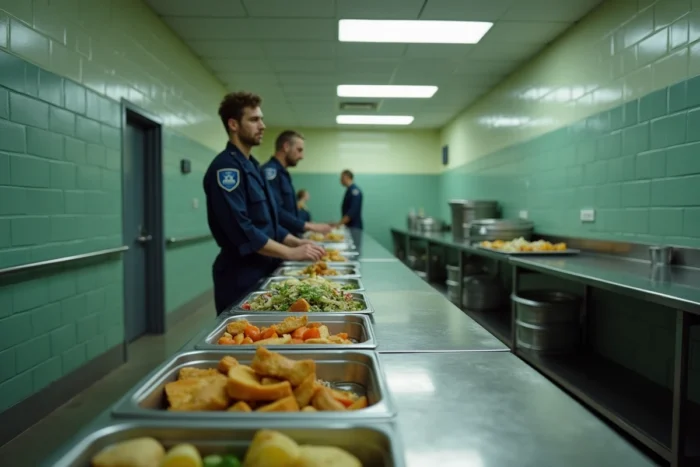
The operation of the canteen in detention is based on a supply system whose pricing mechanisms largely escape public analysis. Understanding the prices and rules of the prison canteen requires going beyond the simple observation of high costs to enter into the logic of public markets, supplier catalogs, and regulatory constraints that structure access to products in cells.
Public markets and private suppliers: the mechanism that sets prices in prison canteens
No national scale governs the pricing of canteen products. Each establishment, or group of establishments, is assigned a distinct public contract. The price differences from one prison to another directly stem from this contractual logic.
The most pronounced factor of volatility remains the change of supplier. The OIP has documented the situation in the prisons of Saint-Quentin-Fallavier, Villefranche-sur-Saône, and Aiton, where the replacement of Sodexo by Elior in October 2022 led to sharp increases in certain items.
Emblematic case: the price of coffee rose from 1.85 euros to 6.57 euros for a comparable packaging. Elior cited a display error coupled with a repositioning of the range towards “Pure Arabica.”
This type of episode highlights a structural flaw. When renewing a contract, the new holder can remove the lowest-priced items without any obligation to maintain alternatives at the same price level. A comprehensive overview of prices and rules of the prison canteen 2026 confirms that the incarcerated person remains captive to a more limited or more expensive catalog, with no possibility of turning to a competing supplier.

Establishments under delegated management (semi-private) operate according to their own grids. The fragmentation of the canteen market persists in 2026.
Supply service in penitentiary establishments: an administrative position that affects prices
The available online comparisons are limited to catalog prices. They overlook the administrative link that conditions these rates: the supply service. Job postings published in 2026 for managers in the supply service in penitentiary centers confirm that this service oversees purchases, pricing policy, and supply chains.
In practice, the supply manager negotiates with the listed suppliers, controls the compliance of deliveries, and checks the applied margins. An under-resourced or poorly equipped supply service has few levers against price increases imposed by the supplier, which is reflected in the price paid by the inmate.
- The supply service checks the compliance between the displayed catalog and the products actually delivered (packaging, weight, brand)
- It manages the individual account of each inmate, identified by their inmate number, from which canteen purchases are deducted
- It arbitrates requests for specific products (food items for dietary needs, adapted hygiene products) within the framework of the internal regulations
- It ensures the follow-up of pricing complaints and forwards anomalies to the establishment’s management
The supply service is the only filter between the supplier and the inmate. Beyond logistics, it conditions the effectiveness of the right to access essential products.
Internal regulations and inmates’ rights: what the arrival guide provides for the canteen
Upon arrival, each incarcerated person receives a newcomer’s guide outlining the general rules of the internal regulations. The modalities for accessing the canteen are included, but they vary by establishment.
The basic principle remains constant: the canteen is the only means of purchasing products in detention. Orders are made from a catalog, according to a frequency specific to each establishment. The inmate must have sufficient funds in their individual account, funded by work in detention, money orders sent by relatives, or assistance provided to those without resources.

The internal regulations also set the list of prohibited products. Some items commonly found in free trade are excluded from prison catalogs for security reasons. Perishable goods are subject to conservation constraints dictated by the cell equipment (presence or absence of an individual refrigerator, access to a cooking point).
Disparities between penitentiary establishments: a problem that inflation alone does not explain
General inflation alone does not account for the price increases observed in the canteen. Price discrepancies between establishments reflect the structure of public markets, much more than the evolution of raw material prices.
A basic product (oil, sugar, soap) can have a single or double price depending on whether the establishment is under public management or a delegated management contract.
- Establishments under delegated management apply the rates negotiated in their own delegation contract, without a national ceiling
For a population whose monthly resources are often very low, these discrepancies weigh heavily. The amount available in an inmate’s account determines their ability to eat properly, maintain hygiene, and communicate with their loved ones through the products offered in the canteen.
The issue of prices in prison canteens remains a matter of public procurement policy. As long as the framework of public markets does not impose uniform pricing caps across all establishments, disparities will persist, and each change of supplier will continue to disrupt the purchasing power of incarcerated individuals.