
In co-ownership, collective heating generates a volume of documents that far exceeds the simple gas or oil bill. Operating contracts, individual consumption readings, work reception minutes: each document has a legal retention period and its own technical utility. Knowing which documents to keep for heating in co-ownership, and how long to keep them, avoids costly disputes when changing the property manager or during regulatory inspections.
Billing items P1 to P4 of the operating contract: understanding before classifying
The heating operating contract in co-ownership is structured around four billing items designated P1, P2, P3, and P4. Item P1 covers fuel or energy, P2 corresponds to routine maintenance, P3 concerns major maintenance and equipment replacement, and P4 relates to the financing of heavy investments.
This classification is not trivial for archiving. An amendment to item P3, for example, commits the co-ownership for several years of parts warranty. If the document disappears, the co-ownership loses its ability to invoke this warranty. Each item of the contract implies a different retention period, aligned with the duration of the warranty or the contract itself.
Co-owners who wish to compile a complete file will find a useful framework for identifying the documents to keep for heating according to their nature and function in managing the installation.
Retention period for co-ownership documents related to heating

The retention period for documents related to co-ownership is five years for current documents. This period applies to proof of payment for co-ownership charges, correspondence with the property manager, and minutes of general meetings.
For heating, this five-year period is a minimum. Certain documents deserve longer archiving:
- Invoices for the replacement of a boiler or a heat exchanger, to be kept for at least the entire lifespan of the equipment, as they condition the manufacturer’s warranty and the traceability of the installation.
- Reports of regulatory inspections of boiler rooms (annual checks, combustion control), useful in case of a disaster or questioning the liability of the co-ownership association.
- Amendments and technical appendices of the operating contract, which specify the performance commitments on consumption (P1 clause) or the obligations for equipment renewal (P3 clause).
- Individualized heating cost statements by housing unit, necessary to justify the distribution of charges to each occupant.
Archiving a fuel invoice beyond five years is of little interest. However, the complete operating contract must be kept for five years after its end, not five years after its signing.
Housing information log and multi-year work plan: two recent documents to include
Since January 1, 2023, the housing information log (CIL) gathers the characteristics of energy renovation works carried out, the materials used, and the manuals of installed equipment. In co-ownership, the CIL concerns private parts, but works voted in general meetings (replacement of collective boilers, insulation of networks, installation of a substation) produce documents that feed this log.
The documents to keep in this context are the general meeting decisions authorizing the works, the selected quotes, the final invoices, the reception minutes, and the energy performance certificates provided by the installer.
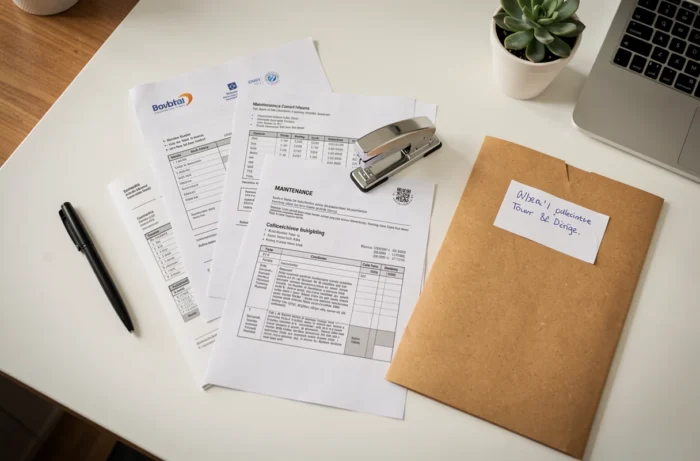
The multi-year work plan (PPT), when adopted, schedules necessary interventions over a ten-year period. The global technical diagnosis (DTG) can identify defects in boiler rooms, piping, or insulation justifying these works. Keeping only the invoices for routine maintenance is not enough to reconstruct the technical and financial trajectory of the installation.
The PPT and the DTG form the documentary basis for any investment decision regarding the heating system. When changing property managers, the absence of these documents delays decisions and can lead to redundant diagnostics, charged a second time to the co-ownership.
Individualization of heating costs: the readings to archive
Every building in co-ownership equipped with collective heating must have a system to determine the consumption of each housing unit.
Individual heat consumption readings are sensitive documents. They serve to distribute charges among co-owners and are regularly contested. Keeping monthly or quarterly readings for five years allows for a response to a late dispute or to demonstrate a consumption deviation justifying works.
Beyond the readings, the contract with the reading service provider (often distinct from the boiler operator) must be included in the file. This contract specifies the frequency of readings, the method of calculating the distribution, and the conditions for replacing faulty meters or distributors.
Organizing archiving between the property manager and the board of directors
The property manager is the legal custodian of the co-ownership archives. In practice, the board of directors has an interest in keeping its own copies of the technical documents related to heating, notably the operating contract, annual inspection reports, and overall consumption readings of the building.
When changing property managers, the complete transmission of the heating file must be verified document by document. The most frequent gaps concern the technical appendices of the operating contract and the old combustion control reports, often lost during the transfer.
A well-maintained heating file is not limited to stacking invoices. It articulates the operating contract, individual consumption readings, the PPT, the DTG, and the documents related to the housing information log. This documentary coherence protects the co-ownership during a dispute with an operator, a charge dispute, or a sale of a lot requiring a reliable technical history.